

Sustainability · 2025
In this section51 topics
- Sustainability Policy & Goals — Overview1 item
- Sustainability Policy4 items
- Sustainability Goals & UN SDGs4 items
- Policy Review2 items
- Business Value Chain1 item
- Stakeholder Analysis1 item
- Environmental Policy & Guidelines4 items
- Environmental Policy Review3 items
- Energy — Plan & Guidelines3 items
- Energy — Electricity Consumption1 item
- Energy — Fuel Consumption1 item
- Energy — Targets3 items
- Energy — Performance & Outcomes2 items
- Water — Plan & Guidelines3 items
- Water — Withdrawal, Discharge & Consumption1 item
- Water — Targets3 items
- Water — Performance & Outcomes2 items
- Waste — Plan & Guidelines3 items
- Waste — Generation, Disposal & Recycling1 item
- Waste — Targets2 items
- Waste — Performance & Outcomes3 items
- GHG — Plan & Guidelines2 items
- GHG — Emissions1 item
- GHG — Emissions Verification2 items
- GHG — Principles & Standards1 item
- GHG — Targets1 item
- GHG Targets — Net Zero2 items
- GHG Targets — Other Targets1 item
- GHG — Performance & Outcomes2 items
- Environmental Legal Incidents1 item
- Social Policy & Guidelines6 items
- Social Policy Review2 items
- Social — Principles & Standards Practised1 item
- Human Rights Due Diligence2 items
- Employees — Plan & Guidelines3 items
- Employees — Workforce1 item
- Employees — Remuneration & Provident Fund1 item
- Employees — Training & Development2 items
- Employees — Occupational Health & Safety1 item
- Employees — Labour Relations3 items
- Employees — Employee Representation2 items
- Employees — Targets2 items
- Employees — Performance & Outcomes1 item
- Customers — Plan & Guidelines3 items
- Customers — Satisfaction Results1 item
- Customers — Targets3 items
- Customers — Performance & Outcomes3 items
- Community & Social — Plan & Guidelines3 items
- Community & Social — Targets1 item
- Community & Social — Performance & Outcomes1 item
- Law Violation Incidents1 item
Sustainability Policy & Goals — Overview
Introduction
The Company operates on the conviction that organizational growth must advance alongside the creation of shared value for all stakeholders, ensuring a better future for generations to come. We drive our sustainable growth strategy through the three pillars of ESG (Environmental, Social, and Governance) and enhance our capabilities with modern technologies, such as Digital Twin and AI, to support the transition toward a low-carbon society. By managing resources with maximum efficiency, we aim to deliver balanced value and resources throughout the entire value chain, while generating tangible results to become an enduring organization that passes on true sustainability to the future
Sustainability Policy
Has a Sustainability Policy
Yes
Policy Description
To officially affirm its commitment, the Board of Directors has enacted the Sustainability and Corporate Social and Environmental Responsibility Policy. This policy was signed and endorsed by the Chairman, with the Corporate Governance and Sustainability Committee appointed to provide strategic direction and ensure comprehensive monitoring of performance, as follows:
Sustainability and Corporate Social and Environmental Responsibility Policy
Dimension | Sustainability Policy |
Environment (E) |
|
Society (S) |
|
Economy and Corporate Governance (G) |
|
Policy Document Link
https://www.teamgroup.co.th/wp-content/uploads/2025/12/14_97-2568_Environmental_Policy_eng.pdf
Page Number in Report
1-3
Sustainability Goals & UN SDGs
Introduction
Sustainability Governance Structure
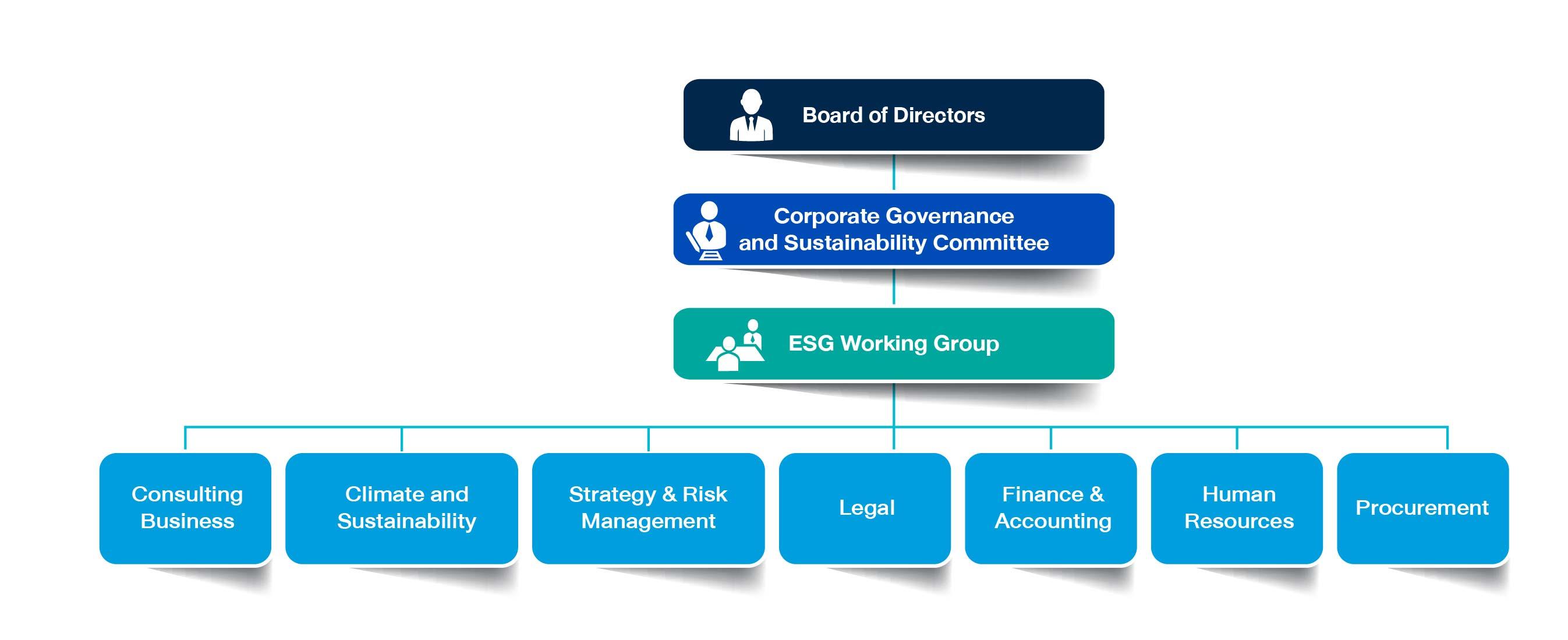
To ensure sustainable business growth alongside environmental and social responsibility under the principles of corporate governance, the Board of Directors has established the Corporate Governance and Sustainability Committee. This committee is tasked with defining and reviewing policies related to Corporate Social Responsibility (CSR), environmental management, and good corporate governance. These policies are reviewed annually to ensure they remain relevant and aligned with the evolving operational context.
The Corporate Governance and Sustainability Committee also oversees and provides guidance on sustainable business practices, ensuring compliance with relevant laws and standards. It fosters an understanding of business ethics among directors, executives, and employees, while reporting performance outcomes to the Board of Directors and implementing appropriate measures to achieve the organization’s sustainability goals.
Furthermore, the Committee has appointed an ESG Working Group comprising management representatives from Operations, Risk Management, Climate and Sustainability Business Units, Accounting and Finance, Corporate Legal, Human Resources, Procurement, and the Corporate Secretary Office. This working group is responsible for proposing development frameworks and acting as a communication hub to ensure sustainability policies are understood and integrated throughout the organization, with regular progress reports submitted to the Corporate Governance and Sustainability Committee.
Has Sustainability Goals
Yes
Goals Description
The Company has established sustainability goals aligned with its business strategy, based on a Materiality Assessment covering Environmental, Social, and Governance (ESG) pillars. These include greenhouse gas emissions reduction, energy efficiency, climate change adaptation, resource and waste management, and water stewardship. Social and governance priorities encompass customer satisfaction, employee health and safety, diversity and inclusion, human rights, fair labor practices, and corporate governance. These initiatives are mapped to the United Nations Sustainable Development Goals (SDGs) to ensure long-term resilient growth, with details as follows:
Materiality Matters
Materiality Analysis
The Company prioritizes the identification and prioritization of material sustainability topics that significantly impact business viability, long-term value creation, and stakeholder decision-making. Our analysis adheres to international standards by evaluating both Impact Materiality (Inside-Out) and Financial Materiality (Outside-In). This comprehensive approach covers economic, social, and environmental dimensions across short, medium, and long-term horizons
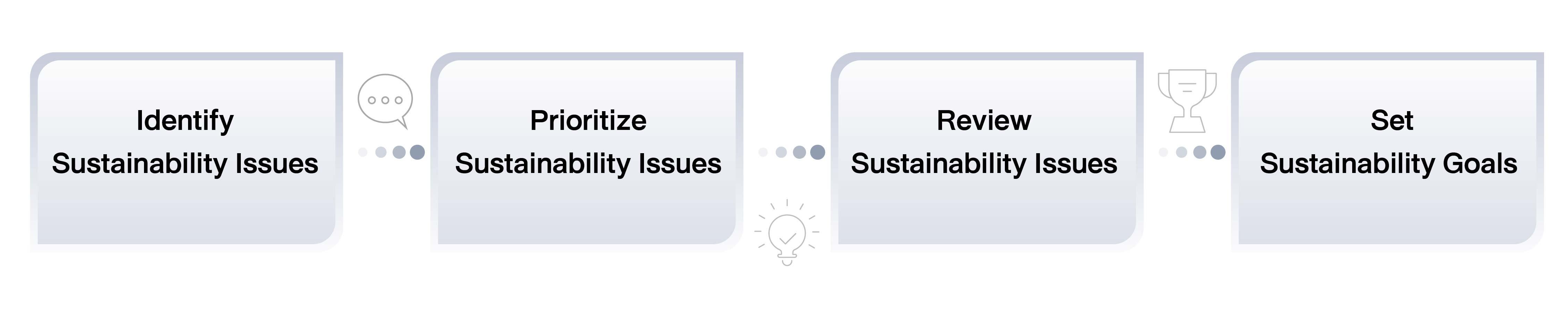
1. Sustainability Materiality Assessment
2. Identification of Sustainability Issues
The Company has identified sustainability issues by considering both the positive and negative impacts that significantly affect the Company’s operations and its stakeholders throughout the value chain. These considerations cover strategic, financial, and operational aspects, as well as compliance with relevant laws and regulations, including business risks and opportunities arising from environmental, social, and governance (ESG) factors
In identifying these issues, the Company has referenced its business characteristics and core strategies, such as engineering and project management services, the development of technology and innovation, services related to greenhouse gas management, and climate change, as well as corporate governance, transparency, and business ethics
In addition, the Company has taken into account external factors that may influence its business context, including industry trends and changes in economic, social, technological, environmental, regulatory, and political conditions. The Company also considers global sustainability frameworks, such as the United Nations Sustainable Development Goals (SDGs), that are relevant to its business operations
3. Materiality Assessment
The Company prioritizes sustainability issues by considering two key factors:
Impact Materiality – the level of impact on society and the environment
Financial Materiality – the level of impact on the Company’s financial performance and its ability to conduct business
The Company applies a scoring scale of 1–5 to reflect the level of significance of each issue. Higher scores indicate issues that have significant impacts on long-term value creation, business risks, and opportunities, as well as issues that are important to stakeholder decision-making.
The results of this assessment are used to prioritize sustainability issues and categorize them into high and very high material topics, which require strategic-level management and oversight by the organization.
4. Validation
The results of the materiality analysis and prioritization are presented to the Corporate Governance and Sustainability Committee to verify their appropriateness, completeness, and alignment with the Company’s context, goals, and strategy. This process ensures formal endorsement of material topics, particularly those with high impact from both an Impact and Financial perspective, which are categorized as the organization's core strategic material issues
5. Sustainability Materiality Review
The Company periodically reviews its material sustainability issues and continuously monitors performance across all areas. Insights derived from the materiality matrix are integrated into corporate strategy formulation, risk management, and the development of action plans and Key Performance Indicators (KPIs). Furthermore, this process defines the roles and responsibilities of management and the Board of Directors, ensuring the Company effectively addresses significant impacts while fostering long-term sustainable value creation
In 2025, the Company conducted a materiality assessment by evaluating impacts on stakeholders alongside strategic business importance. This process involved stakeholder surveys and collaborative consultations between management and the Corporate Governance and Sustainability Committee to identify key sustainability issues. The assessment highlighted 12 material topics: 1) Greenhouse Gas Management, 2) Environmental Impact Consideration, 3) Energy Management, 4) Fair Employment and Compensation, 5) Employee Development and Career Progression, 6) Internal Knowledge Management, 7) Community Development Engagement, 8) Quality Deliverables and Professional Services, 9) Customer Satisfaction, 10) Transparent and Fair Operations, 11) Sustainable Partnerships, and 12) Innovation Development
In 2026, the Sustainability Working Group reviewed the aforementioned material topics, considering the impact of the Company’s business operations on the economy, society, and environment, as well as the potential impact of sustainability factors on financial performance, financial position, and business viability
Additionally, the company has ensured alignment with international frameworks and guidelines, including the United Nations Sustainable Development Goals (SDGs), the Global Reporting Initiative (GRI Standards), the OECD Guidelines for Multinational Enterprises, and the Corporate Governance Code (CG Code 2017). This process also incorporates Human Rights Due Diligence and the FTSE Russell ESG Ratings criteria to ensure that material sustainability issues are identified in accordance with global best practices
Based on this review, the company has refined and identified 13 material sustainability issues as follows:
TEAMG’s Material Sustainability Topics
TEAMG’s Material Sustainability Topics | Relevant SDGs | Relavant GRI Standards | |
Dimension | Material Topics | ||
Environmental (E) | 1. Greenhouse Gas Reduction & Energy Efficiency |
| GRI 302 – Energy GRI 305 –Emissions |
2. Climate Change Adaptation |
| GRI 201-2 – Climate-related financial impacts GRI 302 – Energy GRI 305 – Emissions | |
3. Resource Use and Waste Management |
| GRI 301 – Materials GRI 306 – Waste | |
4. Water Resource Management |
| GRI 303 – Water and Effluents | |
Social (S) | 5. Occupational Health and Safety |
| GRI 403 – Occupational Health and Safety |
6. Human Rights and Fair Labor Practices |
| GRI 401 – Employment GRI 402 – Labor Relations GRI 406 – Non-discrimination GRI 407 – Freedom of Association GRI 408 – Child Labor GRI 409 – Forced Labor | |
7. Employee Capability Development |
| GRI 404 – Training and Education GRI 401 – Employment | |
8. Equality and Diversity in the Organization |
| GRI 405 – Diversity and Equal Opportunity | |
9. Community Development and Social Engagement |
| GRI 413 – Local Communities | |
10. Customer Satisfaction & Data Protection |
| GRI 416 – Customer Health and Safety GRI 418 – Customer Privacy | |
Governance and Economic (G) | 11. Business Ethics and Anti-Corruption |
| GRI 205 – Anti-corruption GRI 206 – Anti-competitive Behavior |
12. Corporate Governance, Risk Management & Transparency |
| GRI 2 – General Disclosures (Governance) GRI 3 – Material Topics | |
13. Innovation and Technology for Sustainability |
| GRI 203 – Indirect Economic Impacts GRI 302 – Energy GRI 305 – Emissions | |



Integrating material sustainability issues with the SDGs and GRI Standards enables the company to manage sustainability systematically with a clear strategic direction aligned with international standards. This approach supports comprehensive and credible stakeholder disclosure, ultimately enhancing corporate reputation and long-term competitiveness
Sustainable Business Development Strategy
The company drives sustainable growth through three core pillars—Economic, Social, and Environmental—as follows:
Upholding Excellence in Integrated Engineering Consulting: Maintaining world-class expertise to deliver high-quality projects that enhance social well-being and quality of life
Expanding End-to-End Service Solutions: Scaling operations across the entire value chain into related business sectors to generate sustainable revenue streams—anchored in transparency, fairness, and the continuous advancement of technology and innovation
Advancing Climate Action and Carbon Management: Providing comprehensive greenhouse gas management services to accelerate the transition toward a sustainable, low-carbon society for all stakeholders
Sustainability Objectives
Environmental Dimension
Operate with environmental awareness while promoting energy and resource efficiency
Support greenhouse gas reduction to advance toward a low-carbon society
Leverage innovation and technology to enhance operational efficiency and minimize environmental impacts
Mitigate environmental impacts from infrastructure projects through design concepts aligned with green policies
Social Dimension
Enhance service capabilities and advance technologies to support national infrastructure development
Promote the well-being of employees, communities, and society as a whole
Foster equality and continuously develop the potential of internal personnel
Support infrastructure development that addresses societal living standards
Economic and Governance Dimension
Strive for leadership in providing high-quality, integrated consulting services while adhering to the SQT corporate values
Elevate corporate governance standards across all business operations
Collaborate with strategic partners to generate sustainable value-added
Strengthen the ESG oversight system within the operational framework
Sustainable Practices
T – Transparency
Operate with robust corporate governance
Foster a culture of transparency and accountability
Ensure transparent disclosure to build stakeholder confidence
E – Ethics
Strictly comply with laws and regulations
Uphold ethics and good governance at all levels of the organization
Foster an organizational culture of integrity and zero tolerance for all forms of corruption
A – Accountability
Integrate ESG into the corporate strategy
Be accountable for the economic, Social, and Environmental impacts
Cultivating a corporate culture rooted in ethics and accountability
M – Mutual Value
Creating shared value for all stakeholders
Empowering talent through reskilling and upskilling to maximize potential
Engaging with communities and society to create shared value
Goals and Key Performance Indicators
Environmental (E)
Indicators | Goals | ||
Year 2025 | Year 2026 | Year 2030 | |
Optimize energy consumption |
|
|
|
Optimize water consumption |
|
|
|
Optimizing corporate waste reduction |
|
|
|
Green space ratio within the project | All projects exceeding the legal minimum of 5% of the total area | All projects exceeding the legal requirement of at least 5% of the total area | All company EIA projects feature green space exceeding the legal requirement |
Indicators | 2030 | 2040 | 2050 |
Greenhouse gas emissions | A 12% reduction in Scope 1, 2, and 3 greenhouse gas emissions compared to the 2024 base year | A 51% reduction in Scope 1, 2, and 3 greenhouse gas emissions relative to the 2024 base year | A 90% reduction in Scope 1, 2, and 3 greenhouse gas emissions relative to the 2024 base year |
Social (S)
Indicators | Goals | ||
2025 | 2026 | 2030 | |
Human rights violation complaints | 0 case | 0 case | 0 case |
Employee training hours | 25 hours/employee/year | 25 hours/employee/year | At least 30 hours/employee/year |
Fair compensation | All employees receive a base salary that meets or exceeds legal labor requirements, with total compensation administered under principles of fairness, transparency, and non-discrimination, governed by the corporate salary structure | Monitor compensation competitiveness based on labor market data, utilizing performance and competency as key factors in determining remuneration | Develop equitable and competitive compensation systems that support corporate growth while ensuring full compliance with labor regulations |
Employee performance appraisal | Conduct semi-annual performance reviews and annual competency assessments to ensure 100% of employees across all levels are evaluated within the specified timeframe | Maintain consistent and standardized performance and competency evaluations across all levels and departments | Maintain consistent and standardized performance and competency evaluations across all levels and departments |
Employee Engagement | Employee engagement level of at least 70% | Employee engagement level exceeding 70% | Employee engagement level exceeding 75% |
Zero Accident | 0 case | 0 case | 0 case |
Lost Time Injury Frequency Rate (LTIFR) | 0 per 1,000,000 man-hours worked | 0 per 1,000,000 man-hours worked | 0 per 1,000,000 man-hours worked |
Governance & Economic (G)
Indicators | Goals | ||
2025 | 2026 | 2030 | |
Ethics Complaints Against Directors, Executives, and Employees | 0 case | 0 case | 0 case |
Corruption Complaints Against Directors, Executives, and Employees | 0 case | 0 case | 0 case |
Business Ethics Training and Assessment for Directors, Executives, and Employees | 60% | 100% | 100% of directors, executives, and employees receive ongoing business ethics training and refresher courses |
Social
Indicators | Goals | ||
2025 | 2026 | 2030 | |
Customer Satisfaction | 95% | 99% | 99% |
Human Rights Violation Complaints | 0 case | 0 case | 0 case |
Community and social grievances surrounding the corporate headquarters | 0 case | 0 case | 0 case |
UN Sustainable Development Goals
| SDG Goal |
|---|
| Goal 3 Good Health and Well-being |
| Goal 4 Quality Education |
| Goal 5 Gender Equality |
| Goal 6 Clean Water and Sanitation |
| Goal 8 Decent Work and Economic Growth |
| Goal 9 Industry, Innovation and Infrastructure |
| Goal 10 Reduce Inequalities |
| Goal 11 Sustainable Cities and Communities |
| Goal 12 Responsible Consumption and Production |
| Goal 13 Climate Action |
| Goal 16 Peace, Justice and Strong Institutions |
| Goal 17 Partnerships for the Goals |
Policy Review
Policy Reviewed This Year
Yes
Policy Changed This Year
No
Business Value Chain
Value Chain Description
The company recognizes that sustainable business operations require cooperation and understanding from all stakeholder groups. Therefore, the company has established a systematic process for identifying and classifying stakeholder groups, including shareholders and investors, customers, employees, partners, government agencies, communities, and the surrounding society. Additionally, it manages potential impacts on stakeholders by operating under transparent and responsible guidelines to balance business growth with social and environmental sustainability.
The company provides communication channels and feedback mechanisms appropriate for each stakeholder group, such as meetings, surveys, communication through annual reports, sustainability reports, the organizational website, and various engagement activities. The information and suggestions received are analyzed and used to continuously improve operations, define strategies, and manage organizational risks. To ensure maximum operational efficiency, the company's value chain is designed to cover both primary and support activities, as follows:
1) Primary Activities Comprising 5 interconnected activities to deliver the highest quality services, as follows:
|
Value chain of an engineering service company ( Engineering Service Value Chain) |
Business Development / Bid for project work. |
Resource Allocation |
Project Management |
Post-delivery services according to the contract. |
|
Related activities: |
|
|
|
|
|
Relevant Stakeholders: |
|
|
|
|
2) Support activities
The company's support activities are departmental activities that help primary activities achieve their goals, comprising a total of 6 activities as follows:
|
Support Activity Value Chain |
Human Resource Management |
Accounting and Finance |
Procurement |
Legal Management |
Technology Management Information |
Information document storage |
|
Related activities: |
Human resources are the primary asset of a consulting company. Human resource management activities involve recruiting qualified personnel for project work and developing human resources to possess knowledge and expertise in their tasks. |
Responsible for accounting and financial management in the company's operations. |
Oversee organizational procurement. To ensure transparency in operations. |
Support project operations in accordance with the contract and assist in resolving issues arising during project implementation. |
Support the company's operations to be fast, efficient, and modern. |
To store information documents within the scope defined in the quality manual, in accordance with the ISO 9001:2015 quality management system. |
Stakeholder Analysis
Stakeholder Analysis
| Stakeholder Type | Stakeholders | Stakeholder Expectations | Response to Expectations | Communication Activities |
|---|---|---|---|---|
| External stakeholders | 2923 · Description: Customers | High-quality work meeting international standards, adhering to professional ethics, and delivering on time. Fair and reasonable pricing. Maximizing satisfaction in service delivery. Providing professional consultation, guiding clients through decision-making by outlining advantages and disadvantages to facilitate easier choices. Efficient project management from inception to completion to minimize operational risks. Maintaining client confidentiality. Producing work with consideration for environmental impact. Developing and utilizing innovation and technology in operations. | - Prepare qualified personnel with the ability to work on projects - Determine appropriate and fair pricing, considering quality and standards - Conduct customer satisfaction surveys an average of twice per project to improve work quality and services - Provide expert personnel to advise customers - Implement Project Quality Assurance (PQA) to inspect work quality before delivery to customers - Strictly adhere to personal data protection policies and confidentiality policies - Comply with environmental laws - Develop innovations and utilize technology in operations to enhance efficiency, quality, and speed, better meeting customer needs | 2941 · Description: Online Communication · 2943 · Description: External Meeting · 2945 · Description: Complaint Reception · 2947 · Description: Satisfaction Survey · 2949 · Other name: Communicate through various channels such as telephone, email, mail, and company website. · Description: Others |
| Internal stakeholders | 2921 · Description: Employees | Appropriate compensation and benefits - Potential development and career advancement - Workplace safety - A good working environment - Emphasis on employee health, both physical and mental - Participation in expressing opinions related to organizational development - Appropriate equipment and facilities for work - Equal and fair treatment and respect for human rights | Ensure employees receive appropriate and fair compensation and benefits. Establish personnel development plans, including training and seminars, to enhance employee potential and career advancement. Implement a Mentoring System to transfer organizational culture and work knowledge from senior to junior employees. Provide a suitable working environment and common areas for relaxation and exercise. Establish channels for receiving feedback and complaints through company communication platforms, such as email, letters, and suggestion boxes. Provide appropriate equipment and facilities to support efficient work. Comply with labor laws and human rights policies. | 2941 · Description: Online Communication · 2942 · Description: Internal Meeting · 2945 · Description: Complaint Reception · 2946 · Description: Employee Engagement Survey · 2948 · Description: Training / Seminar · 2949 · Other name: Communicate through various channels such as email, Morning Screen, Facebook Group, notice boards, circulars, clarification through supervisors, and letters. · Description: Others |
| External stakeholders | 2904 · Description: Investors or investment institutions · 2905 · Description: Analysts · 2913 · Description: Shareholders | The company operates transparently, adheres to good corporate governance principles, and demonstrates social responsibility. It exhibits strong financial performance, consistent growth, and appropriate dividend distribution. Shareholders are treated equally. | Comply with the laws, regulations, and rules of the SEC and SET in accordance with good corporate governance principles. Develop services in new businesses to increase business opportunities, revenue, and profit. Provide accurate and complete information to shareholders, investors, and analysts equally. | 2939 · Description: Press Release · 2941 · Description: Online Communication · 2944 · Description: Annual General Meeting (AGM) · 2945 · Description: Complaint Reception · 2949 · Other name: Analyst meetings, participation in the Stock Exchange of Thailand's Opportunity Day, communication through various media - receiving direct and indirect feedback and complaints through various organizational communication channels such as telephone, conference call, mail, email, etc. · Description: Others |
| External stakeholders | 2899 · Description: Suppliers · 2900 · Description: Business partners | Supplier/Contractor - Transparent and fair operations - Fair contracts and agreements - Full and timely payment for goods and services - Maintaining long-term business relationships and continuous procurement of goods. Partners - Collaboration to leverage each party's strengths to increase opportunities for a broader scope of work and create added value for deliverables - Fair contracts and agreements - Maintaining good relationships with partners | Supplier/Contractor - Maintain transparent and auditable procurement standards - Establish fair agreements with customers and the company - Pay for goods and services as stipulated in the contract - Treat all business partners fairly and equally Partner - Possess good corporate governance policies and anti-corruption policies - Treat all partners fairly and equally | 2941 · Description: Online Communication · 2943 · Description: External Meeting · 2945 · Description: Complaint Reception · 2949 · Other name: Hold joint meetings with partners, Dissemination of information on the company's website, Communication through various channels such as telephone, mail, email, website · Description: Others |
| External stakeholders | 2902 · Description: Community | Assisting, supporting, and promoting for the overall benefit of the community - Participating in community development to foster sustainable growth and strength - Considering the environmental and social impacts on surrounding communities in the development of all projects | - Communicate accurate and complete information to communities surrounding the project - Survey the needs of communities surrounding the company and the project - Organize activities to support and promote engagement between the organization and the community - Participate in improving the quality of life for people in the community - Provide consultation and assistance to the community in engineering and environmental matters | 2941 · Description: Online Communication · 2943 · Description: External Meeting · 2945 · Description: Complaint Reception · 2949 · Other name: Evaluation questionnaire, community development activities, communication with community members through various channels such as telephone, mail, email, website, Facebook · Description: Others |
| External stakeholders | 2928 · Description: Society | Acquisition of engineering and environmental knowledge and information, such as water situation data and BIM knowledge, beneficial to society and the nation. | Provide accurate, complete, and up-to-date information - Organize academic lectures in various fields that are beneficial to society | 2940 · Description: Social Event · 2941 · Description: Online Communication · 2943 · Description: External Meeting · 2945 · Description: Complaint Reception · 2949 · Other name: Seminars, lectures for various associations and institutions, press releases, articles, online news, communication through various channels such as telephone, mail, email, website, Facebook · Description: Others |
| External stakeholders | 2931 · Description: Government agencies and Regulators | Compliance with laws and regulations of government agencies/regulatory bodies - Transparency in business operations | Operate business in compliance with laws and good corporate governance principles - Transparent information disclosure | 2939 · Description: Press Release · 2941 · Description: Online Communication · 2943 · Description: External Meeting · 2945 · Description: Complaint Reception · 2949 · Other name: Meetings between the company and relevant government agencies, reporting on various operational results in accordance with the criteria of relevant agencies, and participating in meetings and exchanging opinions with government agencies and regulatory bodies. · Description: Others |
| External stakeholders | 2929 · Description: Media | Received accurate, complete, and timely performance data, operational information, and useful academic information. Received equal information. | Provide accurate, complete, timely, and equitable information. Treat the media equitably with all stakeholder groups. | 2938 · Description: Visit · 2939 · Description: Press Release · 2941 · Description: Online Communication · 2945 · Description: Complaint Reception · 2949 · Other name: Press release reports, articles, online news, interviews with executives and investor relations, communication through various channels such as telephone, email, and conference calls. · Description: Others |
| External stakeholders | 2898 · Description: Competitors | Treat competitors ethically and lawfully - Opportunities for appropriate collaboration | Conduct business in accordance with the law and principles of good corporate governance. | 2949 · Other name: Meetings with the Consulting Engineers Association or other cooperation networks. · Description: Others |
| External stakeholders | 2925 · Description: Financial institution | Transparency in business operations - Enhance debt repayment capability and contract compliance | Possesses a sound corporate governance policy, an anti-corruption policy, and appropriate risk management planning. Ensures timely debt repayment. | 2941 · Description: Online Communication · 2945 · Description: Complaint Reception · 2949 · Other name: Publication of information on the company's website, communication through various channels such as telephone, email, mail, and joint meetings. · Description: Others |
Environmental Policy & Guidelines
Introduction
Committed to environmentally responsible operations, the company strictly adheres to all applicable laws, regulations, and standards while implementing frameworks to mitigate operational impacts on stakeholder health, safety, and society at large. Recognizing that effective environmental management minimizes legal and reputational risks while fostering stakeholder trust and community acceptance, the company operates under a robust environmental policy and strategic guidelines. These include climate change mitigation, sustainable water management, waste management, and biodiversity conservation. Furthermore, the company promotes practices that reduce the environmental footprint of its business activities and actively contributes to the UN Sustainable Development Goals to ensure business growth aligns with long-term environmental and social sustainability
Has an Environmental Policy
Yes
Policy Description
TEAM Consulting Engineering and Management Public Company Limited and its subsidiaries (“the Company”) are committed to environmental stewardship and fostering a culture of environmental awareness and responsibility among our personnel. To ensure operations align with appropriate standards, the Board of Directors has established the following Environmental Policy as a guiding framework for all employees:
1) The Company strictly adheres to all applicable environmental laws, regulations, and requirements while conducting business with environmental responsibility, utilizing academic principles to ensure minimal environmental impact
2) The Company shall establish clear environmental management processes and guidelines for internal use and projects, with reviews and updates conducted at least annually or upon any significant changes or incidents
3) Environmental management shall address key issues, including biodiversity, waste management, greenhouse gas emissions, air pollutants, water stewardship, resource management, and impacts on local communities and ecosystems
4) Monitoring of environmental performance and operational impacts is required to drive continuous improvement, supported by clear objectives, targets, action plans, and environmental impact assessments
5) Environmental performance shall be publicly disclosed through sustainability reports or other appropriate channels, prioritizing data accuracy and reliability; notably, significant greenhouse gas emissions and energy consumption data must be verified by independent third parties against international standards, with verification results reported to senior management and the Board of Directors
6) The Company shall communicate with executives and employees nationwide to foster knowledge, understanding, and awareness of their role in environmental management
7) The company will collaborate with contracting parties, including contractors, suppliers, business partners, and other stakeholders across its value chain, and will communicate its commitments and expectations to these stakeholders to foster environmental awareness, ensure a profound understanding of the company's environmental management policies, and enhance environmental performance and management both within the organization and among its stakeholders
The company is committed to fostering environmental awareness among all employees to collaboratively define sustainable practices and corporate responsibility
Environmental Guidelines
| Guideline |
|---|
| Electricity Management |
| Fuel Management |
| Renewable/Clean Energy Management |
| Water Management |
| Waste Management |
| Biodiversity Management |
| Greenhouse Gas and Climate Change Management |
Environmental Policy Review
Policy Reviewed This Year
Yes
Review Details
The company is committed to achieving Net Zero Emissions through the following strategic frameworks:
TEAM Consulting Engineering and Management Public Company Limited, "the Company" or TEAMG, recognizes the critical importance of climate change and its interconnected impacts on the economy, society, environment, and all stakeholders. As a provider of engineering, planning, design, project management, and construction supervision services for infrastructure, water resources, energy, environment, and urban development, the Company plays a pivotal role in supporting Thailand's transition toward sustainability. To align with Thailand’s greenhouse gas reduction goals under the Nationally Determined Contribution 3.0 (NDC 3.0), the Board of Directors has established this Net Zero Transition Policy, designating 2024 as the base year to serve as a concrete framework for environmental management as follows:
1. Company's Greenhouse Gas Emission Reduction Targets
The company aims to reduce greenhouse gas emissions across all scopes of its operations, covering Scope 1, Scope 2, and Scope 3, respectively, by setting targets in three phases:
Short-term (2030): 12% reduction from base year
Medium-term (2040): 51% reduction from base year
Long-term (2050): 90% reduction from base year and achieve Net Zero
The company prioritizes emission reduction at the source and will utilize carbon offset measures only to the necessary extent after fully exhausting all potential reduction efforts
2. Operational Framework to Achieve Net Zero Targets
The company will operate based on international standards for greenhouse gas management, including ISO 14064-1, guidelines from the Thailand Greenhouse Gas Management Organization (Public Organization) or TGO, and ESG principles, with a focus on the following key operations:
2.1 Energy Efficiency Improvement and Clean Energy Utilization
Improve energy efficiency within offices and project sites
Promote the use of renewable energy and carbon-reducing technologies
Reduce the need for travel by utilizing online meeting systems and efficient work practices.
2.2 Engagement of Personnel, Partners, and Stakeholders
Foster awareness and a low-carbon organizational culture
Encourage personnel at all levels to participate in greenhouse gas reduction
Collaborate with contractors, partners, and business allies to reduce greenhouse gas emissions across the value chain
Promote environmentally friendly procurement (Green Procurement)
2.3 Integration of Low-Carbon Engineering in Client Projects
The company will integrate Low-Carbon Engineering principles into client projects by:
Recommend material and system alternatives that reduce carbon emissions, such as low-carbon materials and energy-saving equipment
Design structures and systems that utilize resources efficiently, reducing embodied carbon in materials
Support Life Cycle Assessment (LCA) as appropriate for the project
2.4 Continuous Review, Improvement, and Development
Prepare an organizational greenhouse gas inventory (GHG Inventory) annually
Review goals and measures to align with technological advancements and international standards
Develop innovations and engineering practices that support Net Zero targets
3. Governance Structure
To ensure effective operations and the achievement of objectives, the Company stipulates
The Board of Directors is responsible for overseeing direction and approving policies
The Sustainability or Greenhouse Gas Management Working Group is responsible for preparing action plans, monitoring progress, and reporting results to the management and the Board of Directors at least once a year
Integrate Net Zero targets as part of the company's strategic planning
4. Monitoring, Measurement, and Transparency
The Company prioritizes operational transparency and accountability by
Establish performance indicators (for greenhouse gas reduction)
Report Scope 1–3 greenhouse gas emissions annually
Disclose environmental and greenhouse gas performance in the 56-1 One Report, annual reports, and appropriate corporate communication channels
5. The Promulgation
This policy takes effect from the date of announcement, and all business units are required to strictly comply to collectively drive TEAMG toward achieving our Net Zero emissions goal sustainably and tangibly
Policies & Guidelines Changed
| Change |
|---|
| Electricity Management |
| Fuel Management |
| Renewable/Clean Energy Management |
| Water Management |
| Waste Management |
| Biodiversity Management |
| Greenhouse Gas and Climate Change Management |
Energy — Plan & Guidelines
Introduction
Energy management is vital for engineering consultancies as it reduces operational costs, supports sustainable initiatives, and enables clients to develop eco-friendly projects such as green buildings and solar rooftop systems. It also facilitates the integration of energy-saving technologies like Smart Chiller systems. Conversely, a lack of effective control can lead to energy inefficiencies, increased expenses, and legal non-compliance, which may damage client trust and corporate reputation. On the other hand, efficient energy management empowers firms to lower costs, sharpen their competitive edge, and diversify into Smart Energy services. Furthermore, it ensures adherence to environmental standards, effectively driving sustainable development within the engineering industry
Has an Energy Management Plan
Yes
Plan Description
To facilitate continuous and effective energy management, the company has appointed an Energy Management Working Group. This committee is responsible for executing energy management practices in alignment with the energy conservation policy and established methodologies, while coordinating with relevant departments to ensure organizational compliance. Furthermore, the group is tasked with organizing training sessions and activities to foster energy awareness across all levels of personnel, monitoring operations to ensure policy adherence, and reporting conservation results to the Chief Executive Officer. Additionally, the committee provides recommendations for policy reviews and assists management in ensuring full compliance with energy-related legislation
The company has established comprehensive energy management guidelines for both internal operations and broader business activities to meet defined objectives and targets, ultimately promoting maximum energy efficiency and consumption reduction.
Energy — Electricity Consumption
Electricity Consumption
| Metric | Current Year | Previous Year | Two Years Ago |
|---|---|---|---|
| Total electricity consumption within the organization (Kilowatt-Hours) | 1,269,728 | 1,388,832 | 1,323,480 |
| Electricity purchased for consumption from non-renewable energy sources (Kilowatt-Hours) | 1,151,538 | ||
| Electricity purchased or generated for consumption from renewable energy sources (Kilowatt-Hours) | 118,190 |
Energy — Fuel Consumption
Fuel Consumption
| Metric | Current Year | Previous Year | Two Years Ago |
|---|---|---|---|
| Crude oil (Barrels) | |||
| Coal (Metric tonnes) | |||
| Jet fuel (Litres) | |||
| Diesel (Litres) | 78,957.32 | 105,339.8 | 40,800.21 |
| Gasoline (Litres) | 88,261.87 | 96,743.63 | 57,809.27 |
| Fuel oil (Litres) | |||
| Natural gas (Standard cubic feet) | |||
| LPG (Kilograms) | |||
| Steam (Metric tonnes) |
Energy — Targets
Introduction
The company recognizes the impact of fossil-fuel vehicles as a significant contributor to greenhouse gas emissions and global warming. Consequently, we have implemented efficient travel and fleet management strategies to optimize fuel consumption. Furthermore, we are committed to promoting the transition to Electric Vehicles (EVs) to replace internal combustion engine vehicles, aiming to reduce carbon emissions and environmental impact in alignment with our sustainable business practices
Has Set Targets
Yes
Targets
| Target | Base Year | Base Year Value | Target Year | Target Change (%) | Unit |
|---|---|---|---|---|---|
| Reduction of electricity purchased for consumption | 2,023 | 1,223,000 | 2,025 | 1.5 | Kilowatt-hour |
Energy — Performance & Outcomes
Has Performance Results
Yes
Performance Description
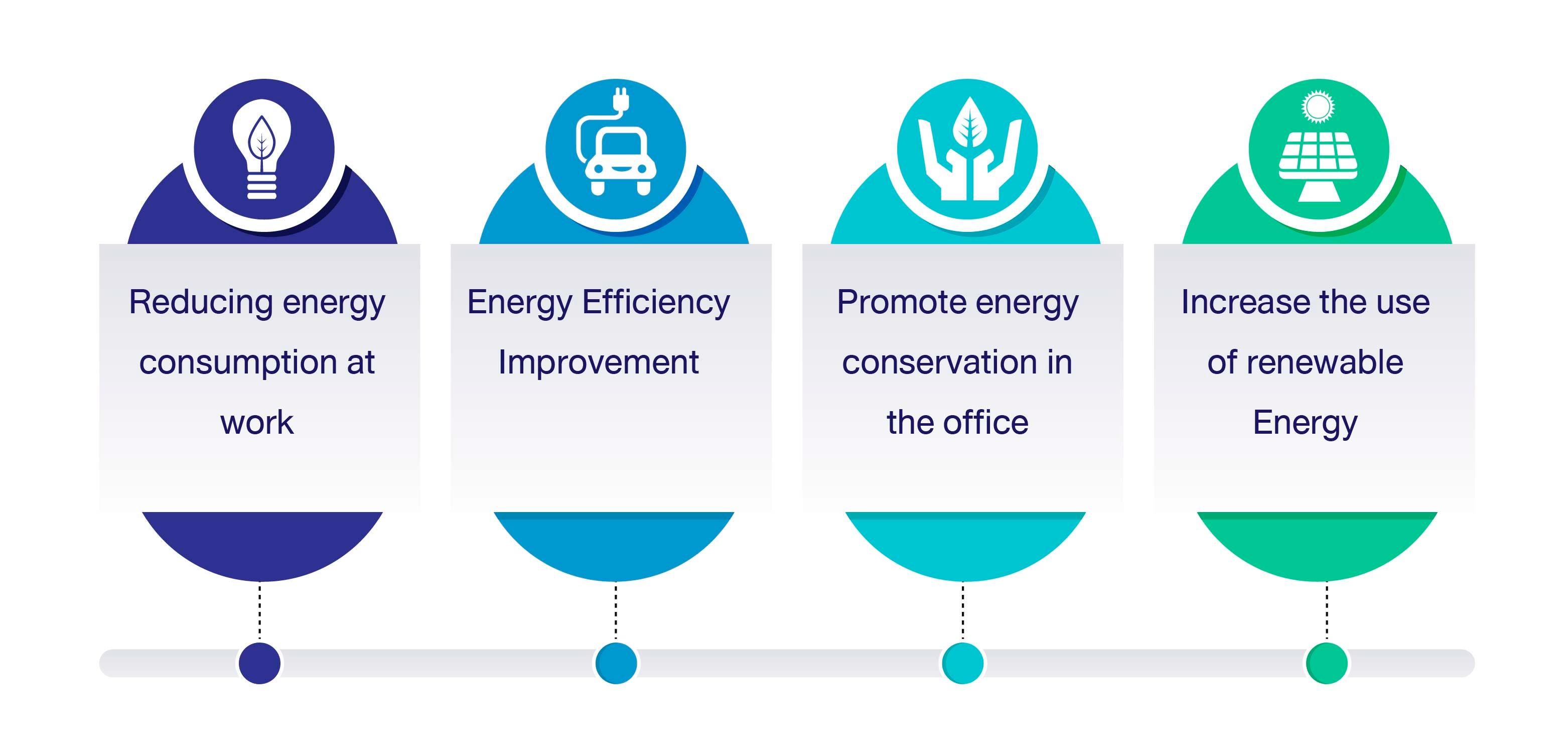
Reducing Energy Consumption in Operations Campaigns encourage employees to turn off lights during lunch breaks daily and to switch to energy-saving equipment throughout the building, such as energy-efficient light bulbs (LEDs). This also includes studying approaches to reduce fuel consumption, such as procuring electric vehicles (EVs) to replace internal combustion engine vehicles
Benefits derived from the project
Year 2025
- Replaced 120 fluorescent lamps with LED bulbs
- Investment budget of 28,000 Baht
- Electricity savings of 7,408.80 kilowatt-hours (kWh) per year
representing 0.62%, equivalent to 35,084.91 Baht/year
Enhancing Energy Efficiency The company studies and develops modern technologies to enhance energy efficiency, focusing on the building's cooling system, as it represents the largest portion of the building's electricity costs. Since 2021, the company has installed a Smart Chiller system at the Team Building to help conserve the building's energy, resulting in reduced electricity expenses for the company.
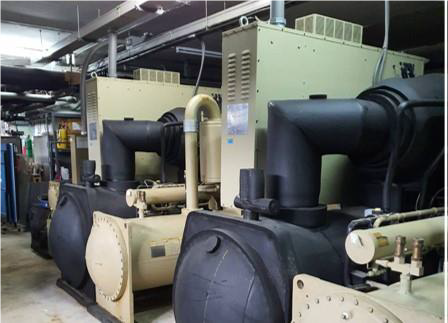
Image of the Smart Chiller system installed at the Team Building
Energy Conservation in the Office The company's energy management working group campaigns and disseminates knowledge through internal communication channels such as the intranet, the company's internal Facebook, public announcement boards in elevators, and public address systems during lunch breaks, etc., regarding energy-saving tips for employees, such as encouraging turning off electrical appliances when not in use and setting air conditioners to an appropriate temperature of 25-26 degrees Celsius
Renewable Energy Production/Consumption The company has invested 2.5 million Baht in installing a 90.09 kWp rooftop PV Solar System at the Team Building to convert clean solar energy into electricity for internal use. The electricity generated by this system helps reduce the amount of electricity purchased from the Metropolitan Electricity Authority (MEA) and the power generation system does not cause environmental pollution, while also contributing to the reduction of global warming
Fuel Energy Management The company mandates that executives and employees utilize fuel energy judiciously, plan off-site operations efficiently, and prioritize environmentally friendly fuel consumption. There is a concept to provide electric vehicles (EVs) for executives to use, aiming to conserve fuel energy and reduce environmental impact, decrease greenhouse gas emissions and air pollution, minimize noise, and lessen reliance on fossil fuels. Furthermore, this reflects the company's commitment to sustainable business operations and alignment with ESG principles. However, the company began collecting fuel consumption statistics this year for the first time to calculate greenhouse gas emissions, thus it does not yet cover all operational processes. The company aims to expand the scope of fuel consumption data collection to be more comprehensive in the coming year
Summary of the Company's Energy Consumption in 2025 The company's total electricity consumption, including renewable energy from the Solar Rooftop, amounted to 1,269,728 kilowatt-hours (kWh)
Water — Plan & Guidelines
Introduction
As a water engineering and management consultancy, we prioritize water efficiency as a strategic driver to reduce operational costs and foster sustainable development. This commitment is reflected in our integrated water management schemes, wastewater system designs, and the deployment of water-saving technologies, all of which optimize resource utilization and minimize environmental impact. By adhering to energy and environmental regulations, we not only scale our business effectively but also mitigate the reputational risks and long-term stakeholder concerns associated with poor water stewardship
Has a Water Management Plan
Yes
Plan Description
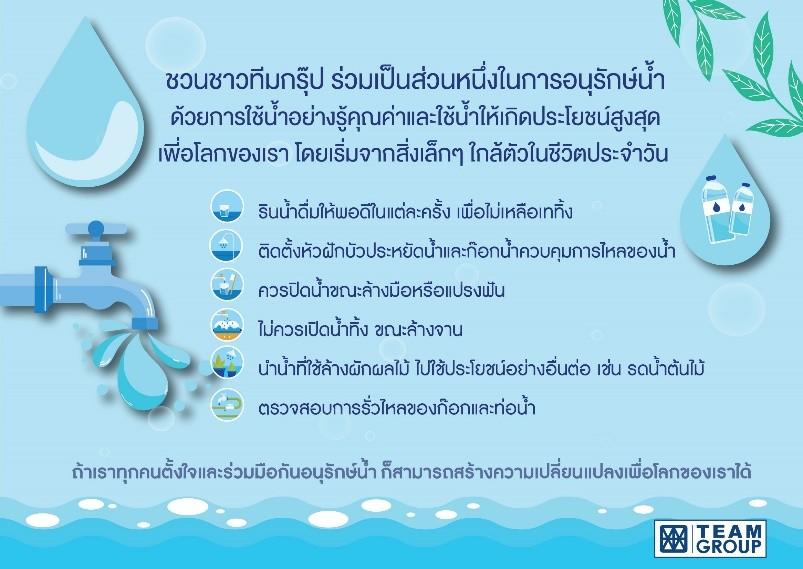
The Corporate Governance and Sustainability Committee, comprising cross-functional departments, is committed to promoting efficient water resource management across all units. The committee has established guidelines focused on reducing consumption, minimizing water loss, and implementing internal water recycling. Key initiatives include installing water-saving fixtures, managing comprehensive wastewater treatment systems for all facility activities, and ensuring relevant departments conduct leak inspections to curb wastage. Furthermore, the committee actively campaigns to cultivate employee awareness regarding the value of water resources and to foster a strong culture of water conservation
Water — Withdrawal, Discharge & Consumption
Water Withdrawal, Discharge & Consumption
| Metric | Current Year | Previous Year | Two Years Ago |
|---|---|---|---|
| Total water withdrawal (Cubic meters) | 21,717 | 21,217 | 19,764 |
| Total water withdrawal by third-party water (Cubic meters) | |||
| Total water withdrawal by surface water (Cubic meters) | |||
| Total water withdrawal by groundwater (Cubic meters) | |||
| Total water withdrawal by seawater (Cubic meters) | |||
| Total water withdrawal by produced water (Cubic meters) | |||
| Percentage of wastewater treated before discharge (%) | |||
| Total water discharge (Cubic meters) | 13,431 | 13,763 | 13,611 |
| Total water discharge to third-party water (Cubic meters) | |||
| Total water discharge to surface water (Cubic meters) | |||
| Total water discharge to groundwater (Cubic meters) | |||
| Total water discharge to seawater (Cubic meters) | |||
| Total water consumption (Cubic meters) | 8,286 | 7,454 | 6,153 |
| Recycled water (Cubic meters) |
Water — Targets
Introduction
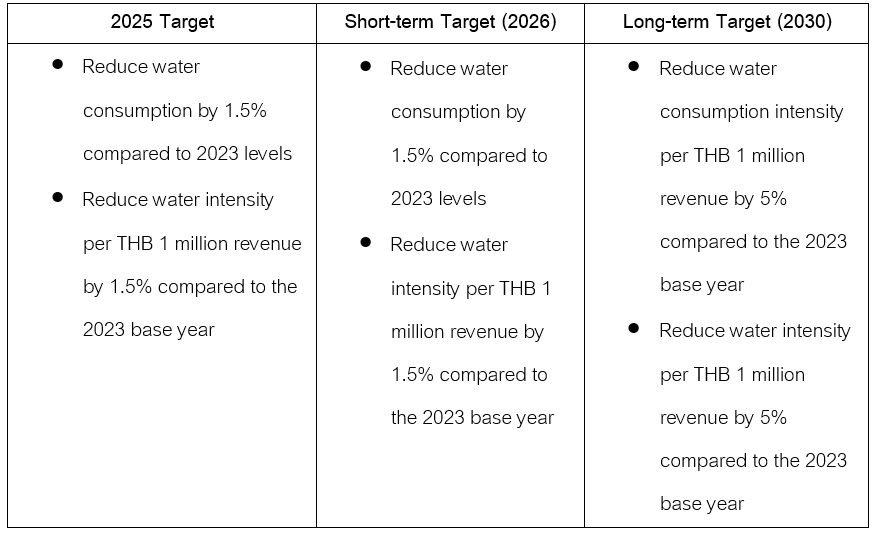
The company has established the following water consumption reduction targets:
Has Set Targets
Yes
Targets
| Target | Base Year | Base Year Value | Target Year | Target Change (%) | Unit |
|---|---|---|---|---|---|
| Reduction of water withdrawal | 2,023 | 19,764 | 2,025 | 1.5 | Cubic meters |
Water — Performance & Outcomes
Has Performance Results
Yes
Performance Description
The company's water management performance is as follows:
Water Consumption Reduction To reduce water consumption, the company promotes a policy of ensuring all fixtures are turned off when not in use, specifically during handwashing, brushing teeth, and dishwashing. For construction projects, water recycling systems are implemented to minimize freshwater usage by collecting and treating wastewater from equipment cleaning and concrete mixing for reuse. Furthermore, water-efficient technologies, including low-pressure nozzles and sensor-activated faucets, are utilized to eliminate unnecessary waste
Water Loss Reduction The company prioritizes efficient water usage by improving water systems in offices and various projects, such as installing automatic shut-off faucets and inspecting and repairing leaks in the plumbing system
Water Circulation / Water Recycling The company promotes water recycling initiatives, such as repurposing dishwashing and vegetable-rinsing water for landscaping. Furthermore, the company has invested in a Water Recycling innovation project within Chulalongkorn University’s Suanluang-Samyan area. Commencing in 2019, the company funded the development of a treatment facility with a daily capacity of at least 240 cubic meters. This system treats domestic wastewater from the CU Terrace and CU iHouse buildings, supplying recycled water back to the university for irrigating the Chulalongkorn University Centenary Park and surrounding areas over an 11-year operational period from 2020 to 2031
Wastewater Management The company has established guidelines for managing all wastewater treatment systems generated from various activities within the building. It utilizes a biological wastewater treatment system with a fixed film aeration system, with a capacity of 100 cubic meters/day, to treat wastewater to meet the effluent quality standards for building discharge control, as per the Ministry of Natural Resources and Environment's announcement, before discharging it into the public drainage system
Water Use Management The company has collaborated with the Royal Irrigation Department
Summary of the company's total water consumption In 2025, the company's water consumption by type is as follows:
Total water consumption of 21,717 cubic meters
Total wastewater discharged into the treatment system of 13,431 cubic meters
Waste — Plan & Guidelines
Introduction
The company prioritizes efficient waste management to reduce operational costs and support sustainability initiatives. Key efforts include minimizing paper usage in reporting, recycling documents, and reducing internal process waste. Effective waste management ensures optimal resource utilization, mitigates environmental impact, and enhances corporate credibility as an eco-friendly business
Has a Waste Management Plan
Yes
Plan Description
The Corporate Governance and Sustainability Committee is responsible for establishing efficient waste management guidelines, focusing on waste reduction, minimizing landfill reliance, and promoting recycling. These guidelines include implementing source segregation measures and repurposing recoverable materials. The Administrative and General Services Department executes these policies by providing categorized waste bins, managing recycling processes, and monitoring office waste volumes. Additionally, in collaboration with the Corporate Communications Department, they drive employee engagement initiatives to promote resource efficiency and ensure the company's waste management aligns with environmental and sustainability standards
Waste — Generation, Disposal & Recycling
Waste Generation, Disposal & Recycling
| Metric | Current Year | Previous Year | Two Years Ago |
|---|---|---|---|
| Total waste generated (Kilograms) | 37,390 | 38,270 | 129,000 |
| Non-hazardous waste (Kilograms) | |||
| Non-hazardous waste - Landfilling (Kilograms) | |||
| Non-hazardous waste - Incineration (with energy recovery) (Kilograms) | |||
| Non-hazardous waste - Incineration (without energy recovery) (Kilograms) | |||
| Non-hazardous waste - Other disposal operations (Kilograms) | |||
| Hazardous waste (Kilograms) | |||
| Hazardous waste - Landfilling (Kilograms) | |||
| Hazardous waste - Incineration (with energy recovery) (Kilograms) | |||
| Hazardous waste - Incineration (without energy recovery) (Kilograms) | |||
| Hazardous waste - Other disposal operations (Kilograms) | |||
| Total reused/recycled waste (Kilograms) | |||
| Reused/Recycled non-hazardous waste (Kilograms) | |||
| Reused non-hazardous waste (Kilograms) | |||
| Recycled non-hazardous waste (Kilograms) | |||
| Reused/Recycled hazardous waste (Kilograms) | |||
| Reused hazardous waste (Kilograms) | |||
| Recycled hazardous waste (Kilograms) |
Waste — Targets
Has Set Targets
Yes
Targets
| Waste Type | Disposal Approach | Target | Base Year | Base Year Value | Target Year | Target Change (%) | Unit |
|---|---|---|---|---|---|---|---|
| Non-hazardous waste | 2758 · Description: Reuse · 2759 · Description: Recycle · 2763 · Other name: 1. Minimizing waste generation 2. Reducing landfill disposal, for instance, by segregating recyclable materials for reuse 3. Initiative for converting organic waste into fertilizer · Description: Other | Reduce waste volume | 2,023 | 38.27 | 2,025 | 1.5 | Tonne |
Waste — Performance & Outcomes
Introduction
In 2025, the company achieved a 2.30% reduction in total waste volume compared to 2024, with waste intensity decreasing from 0.020 tons per million baht in 2024 to 0.015 in 2025. This performance demonstrates enhanced waste management efficiency alongside business growth. Furthermore, hazardous waste generated by the company remains minimal and statistically insignificant
Has Performance Results
Yes
Performance Description
Reduction of Waste and Refuse Generation In the office, the company has a policy to switch to digital document storage and email delivery, aiming for a paperless operation to reduce paper consumption. Examples include various committee meeting agendas, employee evaluation forms, employee leave requests via online systems, and electronic payslip reception. Furthermore, a document management system is implemented in all projects involving construction management and control, reducing the use of internal circulating documents, including accounting and financial documents, as well as procurement documents. At project sites, the company adopts the 3R concept (Reduce, Reuse, Recycle) by reducing unnecessary material usage, separating reusable materials such as scaffolding wood and scrap metal for use in other tasks, and sending recyclable waste materials to recycling plants to minimize the amount of waste requiring disposal
Reduce landfilling, such as separating recyclable waste for reuse The company prioritizes waste reduction and reuse in accordance with the 3R principles: Reduce, Reuse, Recycle. Specifically for waste paper generated from report preparation, there is a campaign to encourage using the blank reverse side for printing and photocopying. After all possible uses, the paper is collected for sale as recyclable material
Project to convert organic waste into fertilizer The company has installed a food waste disposer that operates using a biological decomposition process (Biotechnology), converting food waste into organic fertilizer. This enables a reduction in food waste volume by 80-90% within 24 hours. The objective is to eliminate food waste and minimize food waste disposal as much as possible, resulting in a reduction in weekly waste volume and greenhouse gas emissions. The building's cleaning staff will use the resulting organic fertilizer to nourish plants within the building premises, promoting efficient and tangible resource utilization and circulation
GHG — Plan & Guidelines
Has a GHG Management Plan
Yes
Plan Description
The company has established a strategic Net Zero roadmap aiming for significant long-term greenhouse gas (GHG) emissions reductions by 2050. Under the Long-Term Target, the organization pledges a 90% absolute reduction in emissions across Scopes 1, 2, and 3 by 2050. Regarding the Intensity Target, the company aims to reduce emissions per unit of revenue by 99.5% within the same period. All targets are calculated relative to the 2024 (B.E. 2567) base year
GHG — Emissions
GHG Emissions
| Metric | Current Year | Previous Year | Two Years Ago |
|---|---|---|---|
| Total GHG emissions (Metric tonnes of carbon dioxide equivalent) | 4,983 | 2,884 | 1,372 |
| Total greenhouse gas emissions 1 (Metric tonnes of carbon dioxide equivalent) | 508 | 555 | 314 |
| Total greenhouse gas emissions 2 (Metric tonnes of carbon dioxide equivalent) | 549 | 645 | 598 |
| Total greenhouse gas emissions 3 (Metric tonnes of carbon dioxide equivalent) | 3,926 | 1,684 | 460 |
GHG — Emissions Verification
Emissions Verified by a Third Party
Yes
Verifying Body
2643
GHG — Principles & Standards
Principles & Standards Applied
| Standard |
|---|
| 2671 |
| 2672 |
GHG — Targets
Has Set GHG Targets
Yes
GHG Targets — Net Zero
Introduction
Greenhouse gas emission scope | Base year | Short-term target year | Long-term target year | Target setting standard |
|
|
|
| None |
Greenhouse gas emission scope | Base year | Short-term target year | Long-term target year |
|
|
|
|
Net Zero Targets
| Emission Scope | Base Year | Base Year Emissions | Near-term Target Year | Near-term Target Change (%) | Long-term Target Year | Long-term Target Change (%) | Target Year | Target Change (%) | Unit |
|---|---|---|---|---|---|---|---|---|---|
| 2716 | 2,024 | 2,884 | 2,030 | 12 | 2,050 | 90 | 2,030 | 12 | Metric tonnes of carbon dioxide equivalent |
GHG Targets — Other Targets
Other GHG Targets
| Emission Scope | Base Year | Base Year Emissions | Near-term Target Year | Near-term Target Change (%) | Long-term Target Year | Long-term Target Change (%) | Target Year | Target Change (%) | Unit | Per Unit (Intensity) | Per Unit — Please Specify |
|---|---|---|---|---|---|---|---|---|---|---|---|
| 2716 | 2,024 | 1.52 | 2,030 | 12 | 2,050 | 99.5 | 2,030 | 12 | Metric tonnes of carbon dioxide equivalent | Baht | Baht |
GHG — Performance & Outcomes
Has Performance Results
Yes
Performance Description
Greenhouse Gas Management Performance and Results:
Internal Operations (Scopes 1 & 2): The organization outperformed its short-term targets, with Scope 1 emissions decreasing by 8.47% (to 508 tCO2e) and Scope 2 by 14.88% (to 549 tCO2e), demonstrating the effectiveness of implemented energy-saving measures
Supply Chain (Scope 3): Challenges remain as emissions surged by 133.14% (to 3,926 tCO2e), primarily driven by the procurement of new machinery and equipment aligned with business revenue growth
Environmental Legal Incidents
Legal Violation Incidents
| Metric | Current Year | Previous Year | Two Years Ago |
|---|---|---|---|
| Number of cases or incidents of legal violations or negative environmental impact (cases) | 0 | 0 | 0 |
Human Rights Due Diligence
Conducts Human Rights Due Diligence
Yes
Due Diligence Description
Human Rights (HRDD) and Fair Labor Practices
The Company firmly recognizes that respect for human rights is a fundamental foundation of sustainable business operations and a key factor in building trust among stakeholders throughout the value chain. The Board of Directors has therefore established a Human Rights Policy as a guiding framework for directors, executives, and employees at all levels. The Company also encourages its business partners and relevant stakeholders across the value chain to adhere to this policy to ensure consistent implementation. The Company upholds the principles of good corporate governance and is committed to treating all individuals equally, respecting human dignity, rights, and freedoms, without discrimination in any form.
To ensure that its business operations are transparent, socially responsible, and aligned with international standards, the Company has integrated key principles from the Universal Declaration of Human Rights (UDHR), the United Nations Guiding Principles on Business and Human Rights (UNGPs), and the labor rights standards of the International Labour Organization (ILO) into its organizational management processes. These frameworks serve as mechanisms for the systematic and effective prevention and management of human rights risks.
1. Governance Structure and Management
The Company has established a clear, systematic, and auditable human rights governance structure to ensure that the implementation of the Human Rights Policy is appropriately integrated at all levels of the organization—from policy setting and strategic oversight to operational execution. Roles, responsibilities, and reporting lines are clearly defined as follows:
Board of Directors: Oversees the Human Rights Policy and provides support in terms of resources and implementation direction.
Audit Committee: Monitors and reviews the Company’s human rights performance to ensure compliance with established standards.
Risk Management Committee: Analyzes and manages human rights risks, including considering appropriate mitigation measures for potential issues.
Management: Ensures that all departments operate in accordance with the Human Rights Policy and supports employees in adhering to established practices.
Responsible Functions: Conduct monitoring, assessment, and regular reporting on human rights performance, as well as continuously develop and improve preventive and corrective measures. The Company has assigned the Human Resources Director to provide overall functional oversight. Human rights responsibilities are clearly defined in job descriptions to ensure that designated personnel are accountable and adequately resourced to carry out day-to-day monitoring, evaluation, and reporting in line with established objectives.
All Employees: Comply with the Company’s human rights guidelines and participate in reporting any suspected human rights violations through the Company’s established channels, without discrimination or fear of retaliation.
2. Human Rights Due Diligence (HRDD) Process
The Company has established a Human Rights Due Diligence (HRDD) process across its value chain, integrating it into its standard operating procedures. This ensures that the assessment and mitigation of human rights impacts are carried out continuously, alongside ongoing monitoring, auditing, and performance evaluation conducted every three years.
The HRDD process comprises five key steps as follows:
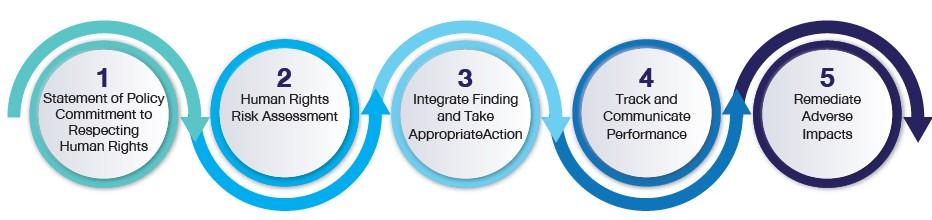
1) Policy Commitment and Principles on Respect for Human Rights The company has announced its Human Rights Policy and published it on the company's website to ensure that all levels of employees, business partners, contractors, and stakeholders involved in the company's business operations throughout the value chain are aware of it and use it as a guiding principle for consistent practice. The current policy is effective from February 26, 2568 (2025).
2) Human Rights Risk Assessment The company mandates human rights risk assessment as part of a comprehensive human rights due diligence process, including actual or potential negative impacts that may arise from the company's business operations throughout the value chain.
The company recognizes that its business operations require coordination with employers, contractors, and subcontractors in an environment with safety risks and time pressures, which may lead to human rights risks, particularly concerning labor rights, working hours, workplace safety, and fair compensation for both employees and business partners throughout the value chain.
The company prioritizes consultation with stakeholders, especially employees, through opinion surveys to identify risks and warning signs that could lead to human rights impacts, in terms of working conditions, equality, and human dignity.
From the employee opinion survey, it was found that the satisfaction level for compensation and benefits was 72.47%, which is lower compared to other issues (82.55–84.52%). Therefore, the company identified this issue as a significant risk to labor rights and fair compensation, impacting employee engagement. This may reflect inequality or pressure from workload and working hours that are not commensurate with remuneration. Although satisfaction with supervisor fairness and working conditions is high, the company maintains preventive measures and secure complaint channels to allow employees to report incidents or concerns without retaliation, and to continuously protect employees' rights and dignity. The company has used these insights to establish operational guidelines as follows:
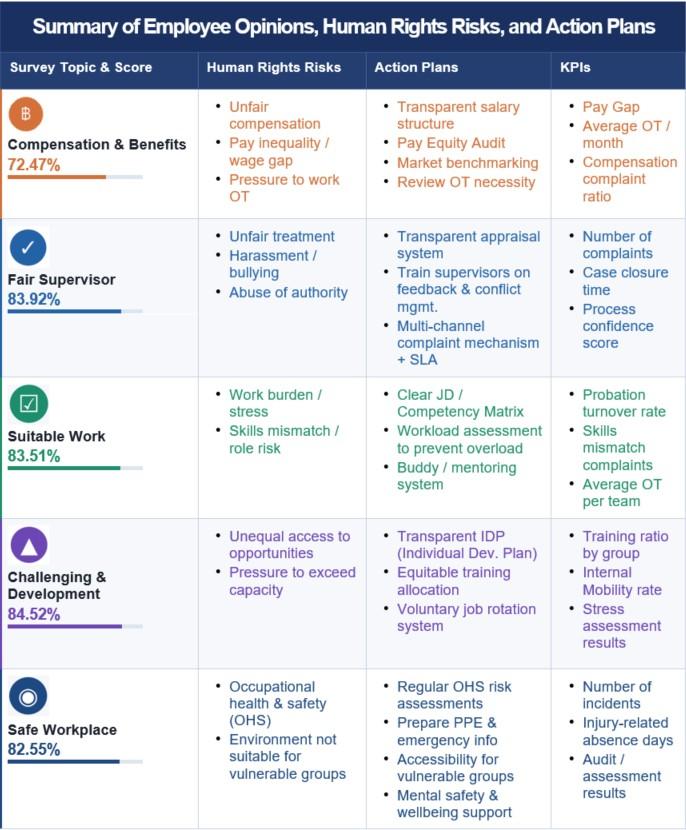
From the human rights risk assessment of employees, the company has incorporated the results of employee engagement and satisfaction surveys as an outcome indicator to reflect employees' perceptions of fair treatment, pride, and intention to remain with the organization, which are crucial factors related to human rights risks in terms of equal treatment and human dignity.
The survey results indicate that employees have a good level of organizational commitment, particularly regarding pride in the organization, dedication to the organization's success, and the intention to continue working with the organization long-term. The company uses these results to determine that the risk of human rights violations related to employees is low (Low Risk), and thus has established management guidelines focusing on continuously maintaining existing measures and activities.
The company uses the survey results as outcome-based monitoring information for human rights risk trends related to employees, without setting them as mandatory Key Performance Indicators (KPIs). This information is used to review and decide whether to maintain, improve, or develop human rights measures appropriate to the organizational context.
The company will use the survey results for comparative analysis in the future to monitor differences in employee perceptions among various groups, such as age, length of service, and job position. This serves as a preventive approach to avoid discrimination risks and continuously promote fair treatment.
3) Integrate Findings and Take Appropriate Action. Following the identification and assessment of human rights risks, the company integrates the results to establish appropriate control and mitigation measures for both existing and potential future risks. The focus is on developing preventive measures to minimize the likelihood and severity of impacts on stakeholders. Furthermore, the company emphasizes assessing residual risk after implementing preventive and corrective measures to review whether the company's human rights management mechanisms are sufficiently effective in controlling and reducing negative impacts throughout the value chain.
4) Track and Communicate Performance The company mandates continuous monitoring and tracking of human rights violation management in accordance with the defined scope, risk issues, and operational plans, including established Key Performance Indicators (KPIs). Responsible departments are designated to report performance results to the Audit Committee, Risk Management Committee, and executive management to ensure that all employees in the company prioritize human rights risks and have a comprehensive and systematic risk management plan in place for any incidents.
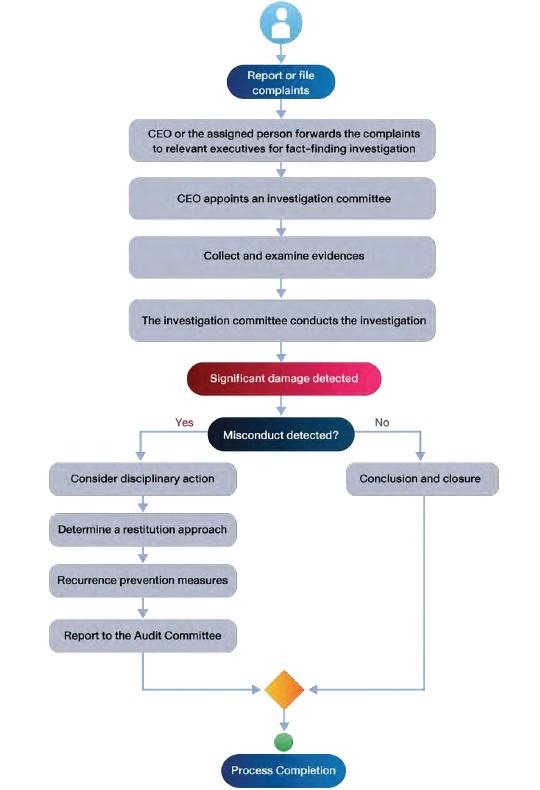
5) Remediate Adverse Impacts The company provides channels for stakeholders to file complaints and a remediation process for those affected by human rights impacts from the company's business activities, through the complaint and whistleblowing channels specified in the company's Whistleblowing and Complaint Policy. There is a systematic process for investigating and remedying human rights violation complaints. The company has a systematic process for considering complaints, investigating facts, and determining corrective/remedial actions, taking into account the appropriateness of measures, fairness to all parties, protection of complainants, and prevention of recurrence.
If the investigation reveals that a violation has indeed occurred, the company has a process for considering appropriate penalties based on the severity, ranging from warnings to legal prosecution. The company also pledges to provide appropriate and fair remedies to affected parties to mitigate damages in accordance with established criteria.
Investigation and remediation process in case of human rights violations.
3. Report on Capacity Building in Human Rights and Data Protection for 2025
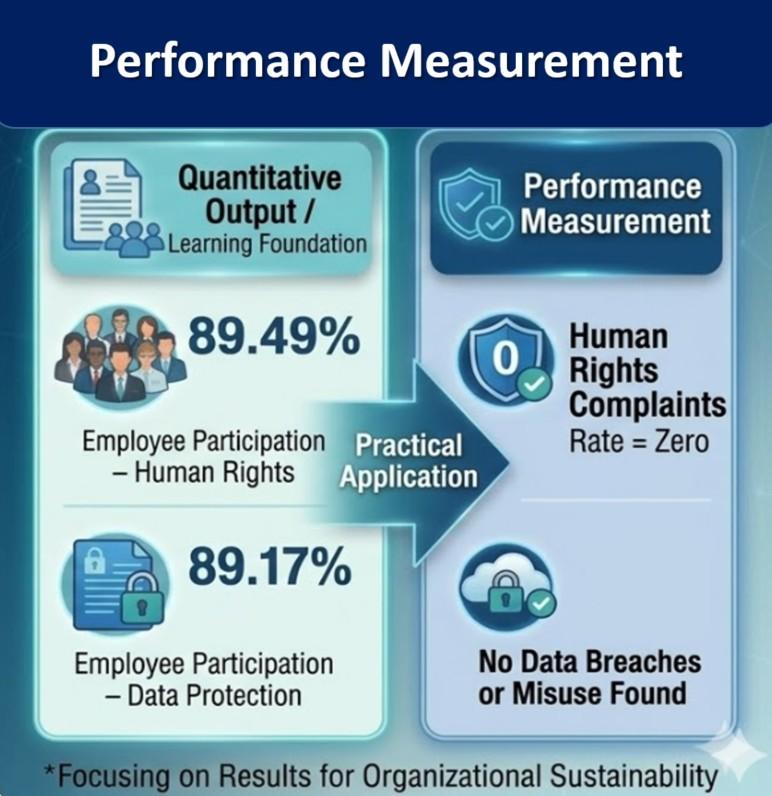
The Company’s Human Rights Policy covers employees at all levels and promotes consistent implementation among business partners, contractors, and stakeholders throughout the value chain. The Company not only emphasizes respect for human rights within the organization but also encourages its partners to conduct business in accordance with the Company’s policies and the Supplier Code of Conduct, thereby jointly preventing human rights violations.
The Company focuses not only on the quantity of training participation but also on tangible outcomes. Knowledge gained from human rights training is integrated into the Human Rights Due Diligence (HRDD) process to reduce the risk of human rights violations across all organizational activities. This is reflected in employee satisfaction survey results regarding fair treatment, as well as the Company’s adherence to personal data protection standards (PDPA), with zero complaints recorded in the past year.
Employees — Plan & Guidelines
Has an Employee Management Plan
Yes
Plan Description
Fair employee compensation
-
The company determines compensation by comparing internal employee compensation, internal salary structures, and reliable external labor market data. This information is used to review the overall appropriateness of compensation. Furthermore, the company monitors employee compensation data, categorized by position level and gender, to support fair and non-discriminatory compensation practices. Additionally, the company utilizes performance appraisal results and competency assessment results as input for compensation considerations, ensuring that compensation is appropriate and aligned with employees' roles and responsibilities.
Employee training and development
-
The company continuously develops and implements training plans for employees across all levels, focusing on skills, knowledge, and capabilities. This is coupled with aligning the management system with the company's strategies and business operations. Various tools are utilized for employee development, such as in-house training, outside training, on-the-job training, site visits, self-learning, Communities of Practice (CoPs), and increasingly, online training via Microsoft Teams. However, classroom-based training remains for practical courses. In 2025, training sessions will be organized to build professional knowledge and understanding, develop work competencies, and ensure personnel are aware of the importance of workplace safety, energy, good governance, and anti-corruption, including:
|
Course types |
Example courses |
Target group |
|
New employees |
|
New employees |
|
Growth and competency development |
|
Employees at each level |
|
Legal requirements |
|
Executives and employees |
|
Management |
|
Executives |
|
Self-development, fostering happiness, and motivation at work |
|
Executives and employees |
The company defines competencies for executives and project manager groups to serve as a framework for capability development. Based on the competency assessment results, the company has established various development approaches, one of which is the development of coaching skills, as this competency still scores below the expected level and could impact team efficiency, operational quality, and personnel retention.
Promoting employee relations and engagement
-
The company provides opportunities for employees to participate in determining appropriate welfare benefits through employee representatives. A Welfare Committee has been established at the workplace in accordance with Section 96 of the Labor Protection Act B.E. 2541 (1998) to perform the following duties:
-
Collaborate with executives to arrange employee welfare.
-
Provide consultation and recommendations to the company regarding employee welfare arrangements.
-
Inspect, control, and oversee the welfare benefits provided by the company to employees.
-
Propose opinions and guidelines for beneficial employee welfare arrangements to the Welfare and Labor Committee.
Child labor
-
The company has established recruitment and employment guidelines in its Human Resources Management regulations, stipulating that employees must be at least 18 years of age. The company strictly verifies the age of employees before employment to ensure that all employees meet the legal age requirements. Furthermore, the company continuously communicates human rights practices to employees and business partners to raise awareness and prevent human rights violations within the company's supply chain.
-
The company requires business partners to conduct self-assessments using the Supplier Self-Assessment form, which covers compliance with laws, regulations, and rules related to labor protection and prohibits the use of child labor below the legally specified age.
Safety and occupational health at work
-
The company prioritizes respecting the human rights of its employees, particularly the right to work in a safe and health-conducive environment. Therefore, the company has established a Safety, Occupational Health, and Working Environment Policy to guide the management and control of risks that may lead to accidents or health impacts on employees, as well as to promote employees working safely according to established standards.
-
The company continuously implements workplace safety measures, such as providing a safe working environment, supplying appropriate personal protective equipment, conducting workplace safety training, and organizing emergency drills, to raise awareness and reduce the risk of work-related accidents.
-
The company continuously collects, analyzes, and monitors health and safety performance data, such as work accident data, statistics on work-related illnesses, results of safety inspections, participation in occupational health and safety activities, and outcomes from "Exercise for Health" activities. This data is used to compare against set targets and to inform the review and improvement of safety measures to ensure they are appropriate and consistent with actual working conditions. Specifically, this includes promoting strong physical health among employees, reducing the risk of non-communicable chronic diseases, alleviating work-related fatigue, and enhancing readiness for safe operations. Furthermore, the company uses the results of activity participation tracking to analyze trends in employee health and well-being, which is then used to plan and continuously develop health promotion activities and improve the working environment. This supports long-term health risk reduction and fosters a culture of health care alongside safe work practices within the organization.
Plan Areas
| Plan Area |
|---|
| Fair employee compensation |
| Employee training and development |
| Promoting employee relations and participation |
| Child labor |
| Occupational health and safety in workplace |
Employees — Workforce
Workforce Data
| Metric | Current Year | Previous Year | Two Years Ago |
|---|---|---|---|
| Total number of employees (Persons) | 1,261 | 1,303 | 1,286 |
| Number of male employees (Persons) | 780 | 826 | 819 |
| Number of female employees (Persons) | 481 | 477 | 467 |
| Total employment of disabled persons (people) | 1 | 1 | |
| Total disabled employees (people) | 1 | 1 | |
| Total male disabled employees (people) | 1 | 1 | |
| Total female disabled employees (people) | 0 | 0 | |
| Total disabled workers who are non-employee (people) | 0 | 0 | |
| Contributions to the fund for promoting and improving the quality of life for disabled persons | 1 | 1 | |
| Total number of male employees in operational level (Persons) | |||
| Total number of male employees in management level (Persons) | |||
| Total number of male employees in executive level (Persons) | |||
| Total number of female employees in operational level (Persons) | |||
| Total number of female employees in management level (Persons) | |||
| Total number of female employees in executive level (Persons) |
Employees — Remuneration & Provident Fund
Remuneration & Provident Fund
| Metric | Current Year | Previous Year | Two Years Ago |
|---|---|---|---|
| Total disabled employees (people) | 960,819,060 | 1,014,951,761.91 | 935,741,437.2 |
| Total male employee remuneration (Baht) | 662,290,436 | 708,591,684.6 | |
| Total female employee remuneration (Baht) | 298,528,624 | 306,360,077.31 | |
| Number of employees eligible to participate in PVD (persons) | 1,161 | 1,239 | 1,211 |
| Total number of employees joining employee provident fund (Persons) | 861 | 846 | 845 |
| Percentage of total number of employees joining employee provident fund to total number of employees (%) | 68.28 | 64.93 | 65.71 |
| Number of PVD members / Total eligible employees (%) | 74.16 | 68.28 | 69.78 |
| Total amount of provident fund contributed by the Company (Baht) | |||
| Total amount of provident fund contributed by employee (baht) |
Employees — Training & Development
Introduction
The company prioritizes the continuous development of personnel potential and skills, setting a target for employees to receive at least 25 hours of training per person per year to ensure that employees possess knowledge, abilities, and skills aligned with the company's business strategies and direction.
Past performance is as follows:
• 2023: 24.79 hours/person/year
• 2024: 31.53 hours/person/year
• 2025: 31.75 hours/person/year
In 2025, the company had a total of 27,492 training hours across the organization, exceeding the set target. The company conducted various forms of training, including In-House Training, Outside Training, On-the-Job Training, Site Visit, Self-Learning, and online training via Microsoft Teams. These training sessions aim to enhance professional knowledge, develop work performance capabilities, management skills, and raise awareness regarding occupational safety, energy, good governance, and anti-corruption, thereby comprehensively strengthening personnel potential.
Such performance reflects the company's continuous commitment to developing personnel potential and supporting the organization's competitiveness and sustainable growth.
Training Data
| Metric | Current Year | Previous Year | Two Years Ago | Remark |
|---|---|---|---|---|
| Average employee training hours (Hours / Person / Year) | 31.75 | 31.53 | 24.79 | The company established a target of no less than 25 average training hours per person per year. The performance for 2024–2025 exceeded the set target. |
| Employee development and training expenses (baht) |
Employees — Occupational Health & Safety
Occupational Health & Safety Data
| Metric | Current Year | Previous Year | Two Years Ago |
|---|---|---|---|
| Total number of lost time injury incidents by employees (Cases) | 4 | 0 | 0 |
Employees — Labour Relations
Introduction
The company has a plan to develop employee engagement as follows:
Voluntary employee turnover (Turnover rate) is 11.34 percent of all employees, with a rate slightly increased from 10.82 percent in 2024 to 11.34 percent in 2025. and the employee engagement assessment result for the organization is 82.59 percent, exceeding the target of not less than 70 percent.
Labour Relations — Introduction
The company prioritizes building employee engagement by making engagement assessment an integral part of the continuous human resource management process, covering all employee levels, to gather feedback on the work environment, work systems, relationships with supervisors, development opportunities, and confidence in the organization.
The company sets an employee engagement target of no less than 70 percent, with historical performance as follows:
-
Year 2024: 77.55 percent
-
Year 2025: 82.59 percent
which is higher than the annual target.
The company has the following voluntary turnover rates:
-
Year 2024: 10.89%
-
Year 2025: 11.35%
with a slight increase in 2025 compared to the previous year.
The company has analyzed the survey results and established improvement guidelines, including:
-
Skill development and career advancement
-
Reviewing compensation and benefits to be competitive
-
Strengthening leadership roles and internal communication
-
Technology and work environment development
-
Promoting organizational culture and teamwork
To continuously enhance engagement and work efficiency.
Labour Relations Data
| Metric | Current Year | Previous Year | Two Years Ago | Remark |
|---|---|---|---|---|
| Proportion of voluntary resignations (%) | ||||
| Total voluntary resignations (Persons) | 143 | 141 | 159 | |
| Male employees who voluntary resigned (Persons) | 99 | 90 | 102 | |
| Female employees who voluntary resigned (Persons) | 44 | 51 | 57 | |
| Percentage of employee turnover leaving the Company voluntarily (%) | 11.34 | 10.82 | 12.36 | |
| Evaluation result of employee engagement | 1 | 1 | The employee engagement level in 2025 was 82.59 percent, which exceeded the target of 70 percent. The company communicated the survey results to employees and continuously incorporated feedback to improve human resource management approaches. |
Employees — Employee Representation
Employees Are Represented Collectively
Yes
Forms of Representation
| Form |
|---|
| Welfare committee |
Employees — Targets
Has Set Employee Targets
Yes
Targets
| Indicator | Target Areas | Base Year | Base Year — Description | Target Year | Target Year — Description |
|---|---|---|---|---|---|
| Employee Training Hours (hours/person/year) | 2984 · Description: Employee training and development | 2,025 | 25 hours/person/year | 2,030 | No less than 30 hours/person/year |
| Fair compensation | 2983 · Description: Fair employee compensation | 2,025 | • 100% of employees receive a basic wage no less than the requirements of labor laws. • Total compensation is based on principles of fairness, transparency, and non-discrimination, using the company's internal salary structure as a framework for compensation payment. | 2,030 | Develop appropriate and fair compensation that can support the company's growth while complying with labor laws. |
| Employee Performance Appraisal | 2990 · Other name: Performance Evaluation · Description: Others | 2,025 | • Performance appraisal of employees twice a year • Competency assessment once a year • 100% of employees at all levels receive appraisals according to the specified period | 2,030 | Maintain standards and consistency in performance and competency evaluations across all employee levels and departments. |
| Level of Employee Engagement with the Company | 2990 · Other name: Level of Employee Engagement with the Company · Description: Others | 2,025 | Employee engagement rate with the company is not less than 70 percent. | 2,030 | Employee engagement with the company exceeds 75% |
| Mortality Rate from Accidents (Zero Accident) | 2988 · Description: Safety and occupational health at work | 2,025 | 0 items | 2,030 | 0 items |
| Lost Time Injury Frequency Rate (LTIFR) | 2988 · Description: Safety and occupational health at work | 2,025 | 0 times per 1,000,000 operating hours | 2,030 | 0 times per 1,000,000 operating hours |
Employees — Performance & Outcomes
Has Performance Results
No
Customers — Plan & Guidelines
Has a Customer Management Plan
Yes
Plan Description
Customer Relationship Management
1. Customer Management Policy and Plan (Customer management Approach)
The Company adheres to core values "Customer Centered" Recognizing that customers are the heart of the consulting and engineering business, the Company focuses on delivering work of the highest quality and safety standards, coupled with building sustainable partnerships, through four main strategies:
-
Product and Service Responsibility ( Product and Service Responsibility ): The Company adheres to business ethics and delivers work according to the highest safety standards, integrating modern innovations and technologies such as BIM (Building Information Modeling) and Drone-based Survey into work processes to enhance design and planning accuracy, reduce the likelihood of errors (Human Error), and help mitigate environmental and social impacts, while sustainably creating added value for customer projects.
-
Building Relationships and Listening to Customer Feedback (Voice of Customer – VoC): The Company focuses on building long-term, customer-centric relationships through a systematic Voice of Customer (VoC) process in every project, utilizing three main channels: In-depth Interviews, Conference Calls, and E-mail Surveys. This data is then used for Root Cause Analysis to continuously improve work processes and elevate service standards to the highest efficiency.
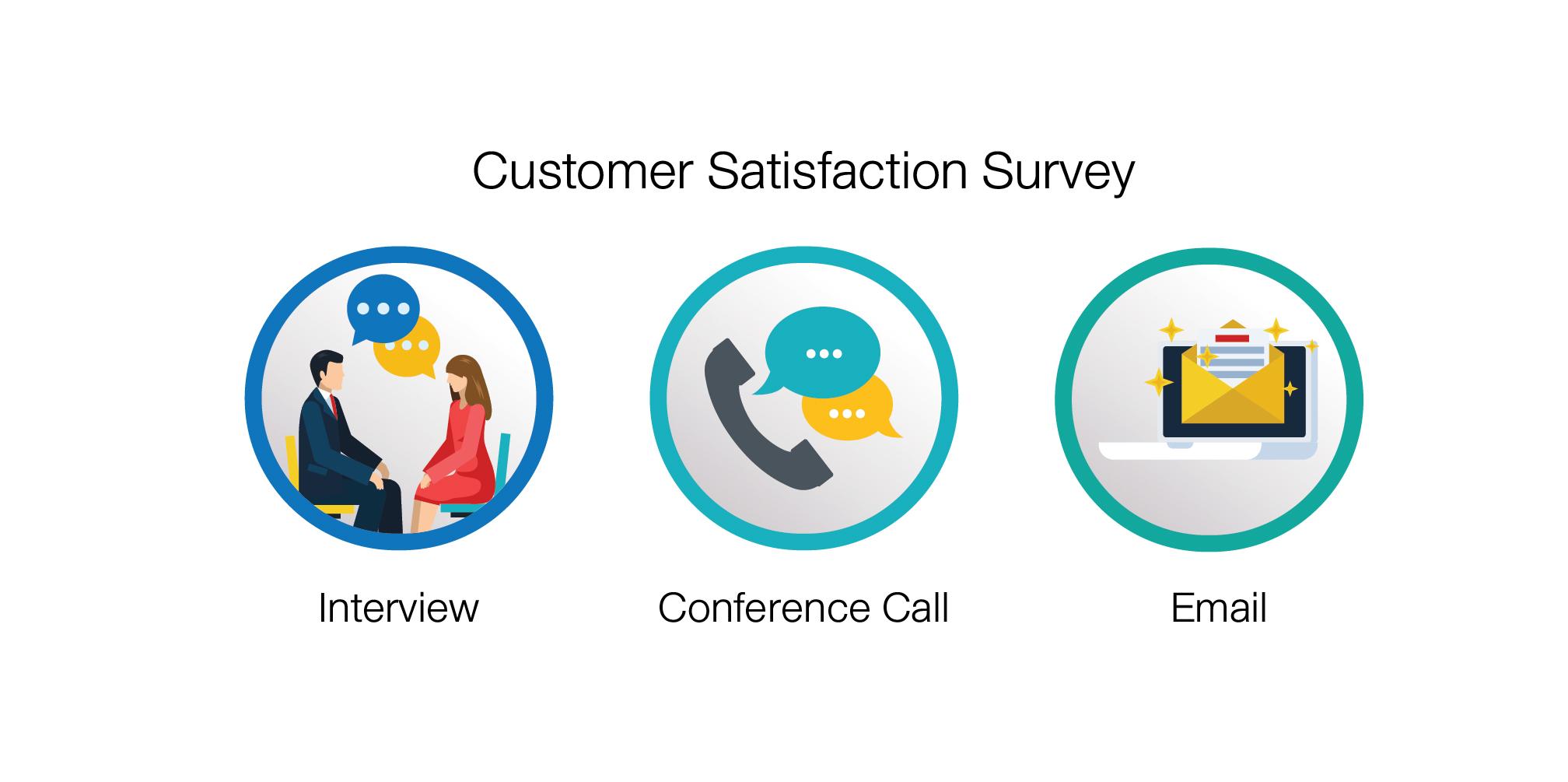
-
Customer Data Privacy: The Company has strict personal data protection measures in accordance with the Personal Data Protection Act ( PDPA ) by clearly defining data access rights and utilizing effective information security systems to prevent data leakage or unauthorized use.
-
International Standard Systems and Corrective Mechanisms: The Company integrates quality management systems ISO 9001:2015 into operational processes to ensure systematic work delivery, along with establishing corrective and preventive mechanisms ( Corrective and Preventive Action ) strictly. If the satisfaction assessment results in the 4 main areas, namely, Quality, Timeline, Service, and Overall Impression any one topic has a score below the standard threshold of 3.00 points The Project Manager is responsible for conducting a root cause analysis ( Root Cause Analysis ) and immediately developing a corrective action plan to improve operational efficiency, meet customer expectations, and sustainably prevent recurrence.
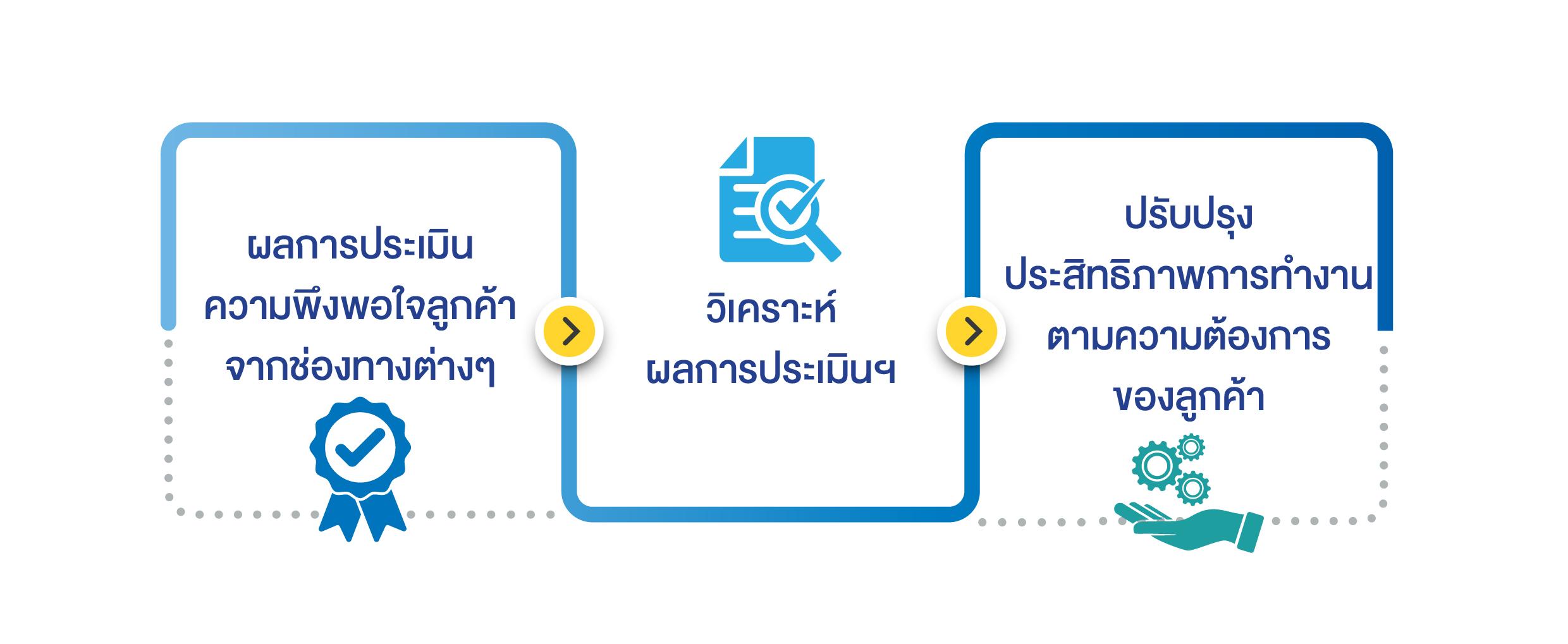
Plan Areas
| Plan Area |
|---|
| Responsible production and services for customers |
| Development of customer satisfaction and customer relationship |
| Protection of customer personal information |
Customers — Satisfaction Results
Customer Satisfaction Results
| Metric | Current Year | Previous Year | Two Years Ago |
|---|---|---|---|
| Evaluation results of customer satisfaction | 1 | 1 | 1 |
Customers — Targets
Introduction
2. Goals and Key Performance Indicators
The Company clearly defines quantitative targets to measure the effectiveness of its customer operations, focusing on developing customer satisfaction and strengthening long-term customer relationships, to reflect the efficiency of the quality management system and innovations implemented. The detailed targets are as follows:
Has Set Customer Targets
Yes
Targets
| Indicator | Target Areas | Base Year | Base Year — Description | Target Year | Target Year — Description |
|---|---|---|---|---|---|
| Percentage of projects meeting overall customer satisfaction criteria | 3009 · Description: Development of customer satisfaction and customer relationship | 2,023 | Percentage of projects achieving overall customer satisfaction, at 92%. | 2,026 | Overall percentage of projects meeting customer satisfaction criteria: not less than 95. |
| Number of significant complaints regarding quality and management standards | 3007 · Description: Responsible production and services for customers | 2,023 | 0 Cases | 2,026 | Must consistently be 0 cases |
| Number of customer data breaches or PDPA violations | 3010 · Description: Consumer data privacy and protection | 2,023 | 0 Cases | 2,026 | Must consistently be 0 cases |
Customers — Performance & Outcomes
Introduction
3. Performance and Customer Management Results (Performance Results)
The Company continuously focuses on elevating service standards to meet customer expectations with responsibility, integrity, and adherence to business ethics. The key achievements are detailed as follows:
Has Performance Results
No
Performance Description
3.1 Customer Satisfaction Assessment and Responsible Operational Statistics (Customer Satisfaction & Responsibility)
To ensure that work processes under international standards can create true value for clients' projects, the company systematically conducts satisfaction surveys for all projects. The results are then used as a database to build trust and retain long-term clients. The operational results for the period 2023 – 2025 are summarized as follows:
Community & Social — Plan & Guidelines
Has a Community & Social Plan
Yes
Plan Description
Improving Quality of Life
1. Healthcare and Well-being of the Community
The Company considers the impact of its construction operations on the health and daily lives of community members. Therefore, various development projects have been initiated to enhance the convenience of local residents and service users, most of whom are members of the community. This is achieved through the design of sustainable infrastructure, such as railway stations that are accessible to people with disabilities, and the development of connecting routes to facilitate public mobility.
The Company organizes training sessions for the community on safe construction standards and project management, enabling residents to apply this knowledge for further local development
2. Donations of Money and Supplies
The Company is committed to supporting social initiatives by optimizing resource utilization (Circular Economy) while simultaneously improving the quality of life for underprivileged groups. One of the organization's longstanding CSR initiatives, now in its 12th consecutive year, is the desktop calendar donation. In 2025, the Company collected over 1,000 used calendars from employees to transform office waste into valuable resources. These materials are used to produce Braille educational media, fostering learning opportunities and sustainably enhancing the quality of life for the visually impaired.
3) Social Volunteerism
The Company prioritizes being an integral part of social development through volunteer activities, supporting disaster relief efforts, improving the quality of life for underprivileged groups, and promoting environmental conservation.
In 2025, the Company implemented volunteer projects through collaboration mechanisms with both the public and private sectors as follows:
Emergency Social Assistance: The Company provided emergency financial aid totaling 240,780 baht to flood victims in critical areas.
Local Relief and Rehabilitation: Financial assistance was provided to flood-affected residents in Nan Province and Hat Yai District, as well as those impacted by the situation along the Thai-Cambodian border. This support aimed to alleviate basic hardships and enable community members to return to their normal lives more quickly (Community Resilience).
Educational Opportunity Rehabilitation: The Company supported the budget for the urgent repair and restoration of Darun Witthaya School, Nan Town Municipality (Ban Suan Tan), which was damaged by floods. This recovery effort ensured students could return to school on time, reducing the risk of dropping out of the educational system due to economic and disaster impacts.
Blood Donation Project: For the 34th consecutive year, over 189 executives and employees across the Group (representing 15% of the total workforce) participated in this great act of giving. A total of 85,050 cc (189 units) of blood was donated to the Thai Red Cross Society through quarterly activities. The blood collected helps maintain the liquidity of the national blood reserve and can be used for medical treatment and emergency life-saving for more than 560 patients (averaging 3 lives saved per unit).
Ecosystem Conservation and Climate Change Response: over 100 executives and employees (8% of the total workforce) collaborated with the Tha Khlo Subdistrict Administrative Organization (SAO) in Saraburi Province to construct 10 check dams and plant 100 trees at Khao Khrao. These efforts help slow water flow, increase soil moisture, and prevent bank erosion during the flood season, resulting in a more fertile surrounding ecosystem. Additionally, in collaboration with the Bangpu Nature Education Center of the Royal Thai Army in Samut Prakan Province, 1,000 mangrove trees were planted to strengthen the coastal ecosystem. This act serves as a marine nursery for the community and functions as a highly efficient Blue Carbon sink. This project is estimated to sequester approximately 9.4–13.4 tCO2e per year (based on the Study of Carbon Sequestration of Rhizophora spp. in Thailand's Mangrove Plantations).
Knowledge Productivity Enhancement
As an integrated engineering consultancy with expertise across various disciplines—including civil engineering, rail systems, infrastructure, project management, environmental science, water resource management, and energy—the Company prioritizes community and social potential development. Guided by the concept of "Knowledge Transfer to Community and Society", we aim to promote learning and understanding of engineering processes and environmental impacts. Our initiatives focus on providing knowledge in engineering, infrastructure development, climate change, and environmental issues to youth, investors, the business sector, and the general public as follows:
1. Exploring Learning Centers Towards an Engineering Project. Now in its 11th consecutive year, this project aims to provide youth with insights into engineering work processes and career guidance. In 2025, the Company hosted 50 Grade 11-12 students from Nakhon Sawan School interested in engineering careers for a site visit at the Lop Buri–Pak Nam Pho Double-Track Railway Project.
Success Metrics: In the past year, 113 participating students successfully passed entrance exams for the Faculties of Engineering. Currently, the Company has recruited former project participants as engineers, contributing to local career stability, providing Skilled Labor back to society, and addressing the long-term shortage of engineering personnel.
2. Scholarship Project. In collaboration with the TEAM Group Foundation, the Company has consistently provided scholarships, educational equipment, lunches, and clothing for 19 consecutive years. The goal is to support underprivileged children, increase educational opportunities, and alleviate the financial burden on low-income parents.
2025 Performance: The Company awarded 400 scholarships totaling 727,000 Baht across Nakhon Sawan, Nakhon Nayok, Chiang Mai, and Bangkok. This initiative effectively reduced the dropout rate caused by financial constraints, promoted educational equality, and achieved a 100% Continuation Rate (from primary to secondary levels) among scholarship recipients.
3. Public Seminars and Expert Knowledge Sharing. As an integrated engineering and environmental consultancy, the Company leverages its multi-disciplinary expertise to support communities and society through its business processes. We focus on transferring expert knowledge and experience to the public to facilitate effective planning, decision-making, and knowledge expansion in response to situations affecting the community, society, and the environment.
Operating Strategies for 2025:
Lectures for Securities Companies and Institutional Investors: Sessions were held for over 130 financial institutions, including Tisco Securities Co., Ltd. and Bualuang Securities PCL, on sustainability crises such as Climate Change, El Nino-La Nina phenomena, and Earthquake Impact Analysis. This enables analysts and fund managers to accurately assess business risks.
Media Outreach: Providing in-depth information through over 90 interviews on television, online media, and leading newspapers (e.g., Thai PBS, Trader KP, TV3, TV5, TNN16, Prachachat Turakij). Topics covered critical issues like "Hat Yai Floods" and the climate crisis, reaching over 1,000,000 views (Reach). Survey results indicated that over 42% of stakeholders consistently follow our information, enhancing Resilience and confidence for businesses and the public in making decisions to mitigate losses from floods and earthquakes.
"Talk to TEAM" Social Media Program: Leveraging the Company’s social media ecosystems, this program was developed to disseminate expert knowledge on pivotal topics, such as "Rain Bombs in the Chao Phraya Basin," "Relocating the Capital: Strategic Perspectives," and "AI Disruption: The New Frontier of the Workplace." The series has established a significant digital footprint, with total engagement exceeding 50,000 views, effectively translating complex engineering insights into accessible public knowledge.
Post-Earthquake Structural Advisory Center:
Established an advisory center to provide initial consultation for buildings affected by earthquakes, supporting government initiatives and alleviating public concern (Public Assistance). By prioritizing the identification of structural risks, the Company aims to prevent timely loss of life and property. Our expert engineering team provided guidance to 398 individuals, identifying critical structural vulnerabilities in 23 cases, which were promptly coordinated with relevant government agencies to ensure public safety.
Performance results
Public Engagement & Media Reach: The Company achieved a total media reach exceeding 1,000,000through strategic interviews with premier television networks, digital platforms, and leading newspapers. Furthermore, our digital educational content garnered over 50,000 viewers across the Company’s social media ecosystems, effectively amplifying our role as a trusted information provider.
Public Awareness & Social Resilience: A comprehensive stakeholder survey revealed that 42% of respondents consistently monitor the Company's insights. This sustained engagement has effectively bolstered Institutional Resilience, empowering businesses and the general public to make data-driven decisions that significantly mitigate potential losses from natural disasters, such as floods and earthquakes.
Critical Safety Contributions: The establishment of the Post-Earthquake Structural Advisory Center successfully bridged the gap between professional engineering expertise and public safety needs. By providing vital structural assessments, the Company helped alleviate public anxiety and ensured that critical risks were addressed through immediate coordination with government authorities.
Plan Areas
| Plan Area |
|---|
| Education |
| Occupational health, safety, health, and quality of life |
Community & Social — Targets
Has Set Community & Social Targets
No
Community & Social — Performance & Outcomes
Has Performance Results
No
Law Violation Incidents
Law Violation Incidents
| Metric | Current Year | Previous Year | Two Years Ago |
|---|---|---|---|
| The total number of cases or incidents of significant violations of laws or regulations regarding social and human rights (Cases) | 0 | 0 | 0 |
| The total number of cases or incidents that cause significant labor disputes (Cases) | 0 | 0 | 0 |
| The total number of cases or complaints related to consumer rights violations (Cases) | 0 | 0 | 0 |
| The total number of cases or complaints related to partner rights violations (Cases) | 0 | 0 | 0 |
| The total number of cases or incidents that cause disputes with the community/society (Cases) | 0 | 0 | 0 |
| The total number of cases or incidents related to cyber security or customer data breaches (Cases) | 0 | 0 | 0 |
| The total number of cases or incidents related to safety and occupational health at work (Cases) | 0 | 0 | 0 |