

Board Performance · 2025
In this section14 topics
- Compliance Monitoring — Overview1 item
- Prevention of Conflicts of Interest4 items
- Prevention of the Use of Inside Information4 items
- Anti-Corruption4 items
- Whistleblowing4 items
- Selection of Directors & Chief Executives6 items
- Selection of Independent Directors3 items
- Director Development3 items
- Evaluation of Board & Subcommittee Performance3 items
- Subcommittees1 item
- Meeting Attendance & Remuneration3 items
- Supervision of Subsidiaries & Associated Companies5 items
- Audit Committee Duty Performance1 item
- Executive Committee Duty Performance1 item
Compliance Monitoring — Overview
Compliance Monitoring — Introduction
The company requires all directors, executives, and employees to acknowledge, understand, and strictly comply with the company's corporate governance policies and guidelines. Executives at all levels are responsible for overseeing continuous and serious compliance, which is considered a crucial ethical principle of the organization. Should any director, executive, or employee be found in violation of these policies, the company will take disciplinary action as prescribed. Furthermore, if such actions constitute a violation of laws or government regulations, the company will refer the matter to the relevant authorities for further action.
In 2025, the Board of Directors' Meeting No. 8/2025, held on December 17, 2025, reviewed the Good Corporate Governance Policy, Business Ethics, and related policies, as well as monitored operational results and provided recommendations for continuous improvement to further enhance the company's corporate governance standards.
The company has promoted and monitored compliance with good corporate governance principles in key areas such as business ethics, prevention of conflicts of interest, insider trading, and anti-corruption, as follows:
Disseminate corporate governance policies and guidelines through the company's website and Intranet system.
Include topics on corporate governance and business ethics in the new employee orientation process.
Prepare employee handbooks and distribute them to all new employees, representing 100%.
Prepare director handbooks and distribute them to all directors and executives, representing 100%.
Provide E-Learning training on business ethics to build and review knowledge and understanding of business ethics principles and related practices.
Monitor compliance with business ethics and related policies through internal oversight processes and the company's whistleblowing channels.
In 2025, the company found no cases of business ethics violations by executives and employees and continuously adhered to the company's good corporate governance policy.
Prevention of Conflicts of Interest
Introduction
The Company Committed to conducting business with integrity, transparency, and ethics, to ensure that the duties of directors, executives, and employees of the company and its subsidiaries are performed correctly and verifiably. The Board of Directors has established a policy for preventing conflicts of interest and a policy for related party transactions in writing. These policies are applicable to both the company and its subsidiaries. The company has disclosed these policies on its website at www.teamgroup.co.th under the heading “Corporate Governance.”
Directors, executives, and employees of the Company must avoid participating in any activities or engaging in related party transactions involving themselves or related individuals/entities that may give rise to conflicts of interest. They must not use the Company's opportunities or information to benefit themselves or others, including engaging in businesses that compete with the Company or related businesses.
Has the Company Acted to Prevent Conflicts of Interest?
Yes
Operations in the Past Year
in In 2025, the company has monitored the oversight and prevention of conflicts of interest as follows:
-
All directors and executives have prepared their own conflict of interest reports in accordance with the criteria set by the company.
-
In considering the For connected transactions that may give rise to conflicts of interest, the company has conducted such transactions as if dealing with external parties under commercial agreements similar to those a prudent person would enter into with general counterparties, with commercial bargaining power free from the influence of being a director, executive, employee, or related person, and without involvement in the approval process for such transactions. These transactions are reported to the Audit Committee for acknowledgment and comments on intercompany transactions every quarter.
Furthermore, connected transactions or transactions that may involve conflicts of interest occurring in the year 2025, these are transactions arising from business necessity, conducted through transparent and fair processes, providing maximum benefit to the company, and the company has not received any complaints regarding misconduct by directors and executives concerning conflicts of interest.
Number of Conflict-of-Interest Cases
| Metric | Current Year | Previous Year | Two Years Ago |
|---|---|---|---|
| Total number of cases or issues related to conflicts of interest (cases) | 0 | 0 | 0 |
Prevention of the Use of Inside Information
Introduction
The company has established measures to prevent and oversee the use of inside information in accordance with good corporate governance principles, by developing an inside information usage policy applicable to both the company and its subsidiaries. This is to prevent the use of important inside information of the company, which has not yet been disclosed to the public, for personal gain or for the benefit of others. The company has disclosed and communicated this policy on its website at www.teamgroup.co.th under the heading "Corporate Governance," with the key points summarized as follows:
must maintain the confidentiality and/or internal information of the company.
must not disclose or seek benefits from the company's confidential and/or internal information for oneself or for the benefit of any other person, whether directly or indirectly, and regardless of whether compensation is received.
must not trade, transfer, or receive transfer of the company's securities using confidential and/or internal company information, and/or enter into any other legal acts using confidential and/or internal company information, which may cause direct or indirect damage to the company.
Directors and executives of the company are obliged to report changes in the company's securities holdings to the Securities and Exchange Commission, in accordance with Section 59 of the Securities and Exchange Act B.E. 2535 including changes in securities holdings by spouses and minor children. A copy of such report must be submitted to the company on the same day it is reported to the Securities and Exchange Commission, which is required to be completed within 3 business days. Directors and executives must be aware of and strictly comply with the penalties stipulated in the said Act.
Has the Company Acted to Prevent the Use of Inside Information?
Yes
Operations in the Past Year
In 2025, the Company adhered to good corporate governance principles. The Company Secretary has provided written notification to directors, executives, and employees involved in the use of inside information, including their spouses and minor children, regarding the blackout period for buying, selling, transferring, or receiving transfers of the company's securities during 1 month prior to the continuous quarterly public disclosure of financial statements, and also notified them to report changes in securities holdings, both their own, their spouses', and their minor children's, to the Securities and Exchange Commission and to the Company Secretary within 3 business days from the date of such change.
The Board of Directors has assigned the Company Secretary to prepare a report on the company's securities holdings by directors and executives, including their spouses and minor children, to be submitted to the Board of Directors quarterly. This annual report also discloses the securities holdings of directors and executives.
For the year 2025, the Company found no instances of directors or executives violating the policy on insider information usage and the information disclosure policy, nor did it receive any complaints regarding such misconduct.
Number of Inside-Information Cases
| Metric | Current Year | Previous Year | Two Years Ago |
|---|---|---|---|
| Total number of cases or issues related to the use of inside information to seek benefits (cases) | 0 | 0 | 0 |
Anti-Corruption
Has the Company Acted on Anti-Corruption?
Yes
Operations in the Past Year
The company places great importance on good corporate governance and transparent business operations. Therefore, it has established an anti-corruption policy, human resource management policies to support anti-corruption, policies and guidelines for preventing corruption in procurement, and anti-corruption practices. These serve as guidelines for the Board of Directors, executives, and employees at all levels. The policies are reviewed annually to ensure their suitability and alignment with the operational context and relevant laws. In the year 2568 The company reviewed its anti-corruption related policies at the Board of Directors meeting No. 8 / 2568 On 17 December 2568
Under this policy, the company requires all personnel to refrain from offering, giving, receiving, or soliciting bribes, benefits, or any form of compensation from external individuals or entities, in any form, with the aim of gaining unlawful advantages or creating an unfair advantage in the company's operations. The company does not condone any acts that constitute corruption towards government officials, individuals, or other entities, nor does it permit the donation of money, goods, or any other benefits that could be used as a channel for bribery or be interpreted as supporting corruption.
Furthermore, the company has a policy to refrain from providing financial support or any benefits to political parties, political groups, or related individuals, to prevent business advantages or personal benefits that could affect the organization's neutrality and governance principles.
Additionally, the company requires personnel to avoid actions that create conflicts of interest. If any action constitutes a conflict of interest with the company, the individual concerned must report the conflict of interest through the designated channels.
The key principles of the anti-corruption policy are as follows:
Prohibit offering, paying, demanding, agreeing to, or receiving any bribes or benefits from any person or entity, whether directly or indirectly, to create reciprocal advantages or for benefits related to the company's business.
Prohibit engaging in unlawful transactions with government officials, individuals, or any entities, whether directly or indirectly.
Prohibit donating or providing any financial support to individuals or other entities in a manner that could serve as a channel for bribery.
Prohibit providing financial support or any other benefits, whether directly or indirectly, to political parties, political groups, or individuals involved in politics, to gain business advantages or for personal and associated benefits.
Process for monitoring and preventing corruption within the organization
1) Business Risk Assessment
The company conducts quarterly corruption risk assessments, with the Risk Management Committee performing the assessment and reporting the results to the Risk Management Committee, the Executive Committee, the Audit Committee, and the Board of Directors, respectively. Appropriate risk management guidelines are also established. The company strictly adheres to procurement regulations and has implemented control measures and monitoring processes for operations that may pose a risk of corruption. The company has provided channels for stakeholders to report tips, suggestions, or complaints regarding corruption (Whistleblower) including violations of the code of conduct by personnel and company partners, through the company's website and email. Furthermore, a committee has been appointed to consider and investigate various complaints transparently and verifiably.
2 ) Establishing Guidelines
The company has prepared a risk management manual and published it through the internal website system (Intranet). The components of risk management have been defined to align with business operations and management processes. This manual serves as an important guideline for implementing risk management and is designated as the responsibility of all departments to apply it in practice, to enhance efficient management and reduce the risk of corruption.
3 ) Employee Communication and Training
The company has communicated its anti-corruption policy to ensure that directors, executives, employees within the group, and all stakeholders are aware of it, by publishing the policy on the company's website at www.teamgroup.co.th under the topic "Corporate Governance" as well as through the internal website system ( Intranet ), and included as a training topic in new employee orientation. and included in the employee manual to ensure widespread understanding and compliance. In summary, the results of employee communication and training are as follows:
Communicate and raise awareness on anti-corruption and business ethics with company directors and executives, 100% through the director's manual/email, Intranet system/company website, and communicated to 100% of employees through new employee orientation/employee manual/email, Intranet system/company website.
Personnel acknowledged the policy on preventing corruption in procurement and business ethics via an online form, with a total of 1,058 persons, representing 83.3%
trained personnel on anti-corruption through the course E-Learning of CAC in the course Introduction to Anti-Corruption to enhance knowledge, understanding, and promote strict adherence to the guidelines. A total of 1,044 persons, representing 82.3%
Table showing communication and awareness building on anti-corruption and business ethics
Personnel | Topics communicated | Number | Percentage | Communication Channels |
1 . Directors | Anti-Corruption Policy | 9 | Percentage 100 | Director's manual / email System Intranet / company website |
2 . Executives | 9 | Percentage 100 | Director's manual / email System Intranet / company website | |
3 . Employees | 1,261 | Percentage 100 | New employee orientation / employee manual / email System Intranet / company website |
Acknowledgement of Anti-Corruption Policy and Business Ethics
Total personnel (persons) | Personnel who acknowledged the policy (persons) | % of all employees trained |
1,261 | 1,0 58 | 83.9 |
Table showing anti-corruption training
Total personnel (persons) | Personnel who attended training (persons) | Personnel who completed training (persons) | % of all employees trained |
1,261 | 1,044 | 1,044 | 82 .8 |
4) Monitoring and Evaluation
The company monitors and evaluates risk management quarterly through the Risk Management Committee and submits evaluation reports to the Executive Committee, Audit Committee, and Board of Directors for their acknowledgment, respectively.
5 ) The adequacy of the process has been reviewed.
The Audit Committee has reviewed the effectiveness of risk management, considering internal control system audit reports prepared by internal auditors every two quarters, as well as auditors' reports every quarter.
Additionally, the company has officially declared its intention to join the anti-corruption network to demonstrate its commitment to preventing and combating all forms of corruption. Currently, the company is preparing documents, policies, internal control procedures, and monitoring and evaluation systems to apply for anti-corruption certification in the year 2569 according to the criteria and guidelines of the Thai Private Sector Collective Action Against Corruption (CAC) project. ( CAC ) Driving the certification application and anti-corruption measures implemented by the company's Anti-Corruption Working Group, which coordinates and monitors the progress of activities and evidence according to requirements CAC Furthermore, the Board of Directors has assigned the Corporate Governance and Sustainability Committee to oversee the overall governance. to ensure operations align with good governance principles. Transparency
Anti-Corruption Performance Results
In the year 2568, the company has monitored anti-corruption operations in all processes, including tracking tips and complaints. The monitoring results found no cases of corruption involving the company's directors, executives, or employees, which is in line with the company's set goals.
Table showing monitoring results of Integrity and corruption within the company
Monitoring issues | Target | Result |
Corruption and bribery within the company | 0 Case | 0 Case |
Form of Anti-Corruption Operations
| Operation |
|---|
| Review of appropriateness in anti-corruption |
| The participation in anti-corruption projects |
| Assessment and identification of corruption risk |
| Communication and training for employees on anti-corruption policy and guidelines |
| The monitoring of the evaluation of compliance with the anti- corruption policy |
| Review of the completeness and adequacy of the process by the Audit Committee or auditor |
Number of Corruption Cases
| Metric | Current Year | Previous Year | Two Years Ago |
|---|---|---|---|
| Total number of cases or issues related to corruption (cases) | 0 | 0 | 0 |
Whistleblowing
Introduction
The Company Committed Operate based on good corporate governance principles, with a clear anti-corruption policy and strict adherence to business ethics. The company has established a whistleblowing and complaint policy to receive complaints regarding corruption, rights violations, or actions that violate laws, regulations, or business ethics from all groups of employees and stakeholders. There is a mechanism to protect informants, and importance is placed on keeping complaint information confidential to assure complainants that they will be treated fairly and safely. The company guarantees that there will be no termination of employment, demotion, job transfer, or any actions that may constitute harassment against whistleblowers or related individuals. The company keeps all whistleblower information and investigation data confidential and restricts access to information only to relevant personnel. In cases of corruption, violation of business ethics, or human rights violations, the company has stipulated penalties based on work regulations and may be subject to legal penalties if the act is illegal.
In the investigation process, the company has assigned the Chief Executive Officer to consider appointing an investigation committee. This committee is responsible for gathering evidence, verifying facts, and recommending solutions for the complaints, as well as defining procedures for handling cases of corruption and ethical violations, and processes to prevent recurrence.
Procedure for handling tips and complaints regarding corruption and business ethics violations
Upon receiving a tip-off, the Chief Executive Officer or assigned person shall forward the matter to the relevant executives for preliminary fact-finding. Once the company receives a tip-off or complaint, it shall acknowledge receipt to the whistleblower or complainant (if their identity is known or contactable) within 3 business days from the date of receipt.
The Chief Executive Officer shall appoint an investigation committee to gather evidence and conduct investigations, which must be carried out transparently and fairly. The investigation committee shall complete the investigation and fact-finding within 30 business days from the date of appointment, unless there is a reasonable necessity, in which case the reasons must be reported and an extension requested from the Chief Executive Officer for consideration.
Once a conclusion is reached, the investigation committee shall summarize the findings and submit a report to the Audit Committee. If the complaint causes or may cause significant damage, a report must be submitted without delay, along with proposed solutions.
If no wrongdoing is found, summarize the results and close the case. If wrongdoing is found, consider disciplinary action, report to the Audit Committee, and propose preventive measures to avoid recurrence.
The members of the Investigation Committee shall inform the complainant of the outcome of the consideration within 30 business days
Utilize the investigation and corrective action results to enhance the effectiveness of anti-corruption processes within 60 days
Process to prevent recurrence of corruption and business ethics violations
Implement corrective measures, such as changes in policies, practices, or work processes.
Provide training to employees on business ethics and appropriate practices.
Implement stricter internal control measures to reduce the risk of repeated violations.
Monitor the implementation of corrective and preventive measures to evaluate their effectiveness.
Continuously review work processes to align with the company's ethical standards and regulations.
Report operational results and preventive measures to the Audit Committee periodically to ensure effective oversight.
Channels for Whistleblowing and Complaints regarding Corruption and/or Ethical Violations/Human Rights Violations
Suggestion and complaint box at the Human Resources Department office
Whistleblowing and complaints directly to
Supervisors at all levels are trusted by employees
Human Resources Department
Internal Audit Department
Company Secretary
Audit Committee
Board of Directors
Website of the company : https://www.teamgroup.co.th under the menu “Good Corporate Governance” > “Whistleblowing and Complaint Receiving System”
Email: Send directly to the Audit Committee at whistleblowing@team.co.th
Send directly by mail to the Board of Directors or the Audit Committee at
Team Consulting Engineering and Management Public Company Limited
151 Nuanchan Road, Nuanchan Sub-district Bueng Kum District, Bangkok 10230
Hotline 02- 509- 9000 ext. 1707
The Whistleblowing and Complaint Policy can be studied under the Topic “Corporate Governance” on the company website https://www.teamgroup.co.th > Corporate Governance
Has the Company Implemented Whistleblowing Procedures?
Yes
Operations in the Past Year
In 2025, the Company monitored operations concerning ethical violations, corruption, and human rights violations across all processes, including the tracking of whistleblowing and complaints. The monitoring results revealed no instances of ethical violations by the Company's directors, executives, or employees, which aligns with the targets established by the Company.
Number of Whistleblowing Cases
| Metric | Current Year | Previous Year | Two Years Ago |
|---|---|---|---|
| Total number of cases or issues received through whistleblowing channels (cases) | 0 | 0 | 0 |
Selection of Directors & Chief Executives
Selection — Introduction
Nomination of Directors
The criteria for director and senior executive nomination are published in Section 6.1.1 Policies and Guidelines for the Board of Directors. In 2025, the Company had given minor shareholders the opportunity to participate by proposing additional meeting agendas and nominating a knowledgeable and qualified person for consideration as a director or submitting questions in advance prior to the 2025 Annual General Meeting of Shareholders on the Company's website: www.teamgroup.co.th, under the header “Investor Information>Shareholder Information>Shareholders Meeting,” from October 1, 2024 to December 31, 2024. However, during such a period, no meeting agenda, questions, or nominated candidate for directorship was proposed. The Nomination and Compensation Committee considered the qualifications of the directors who were due to retire by rotation in the year 2025, namely 1) General Wichien Sirisuntorn and 2) Ms. Suwimon Kritayakiarn. The Committee also considered and proposed to the Shareholders’ Meeting the appointment of Asst. Prof. Dr. Denpong Sudphakdee to serve as an Independent Director, replacing the director who retired by rotation and did not wish to be nominated for reappointment for another term.
The consideration was made in accordance with the relevant laws, regulations, and the Company’s Board Charter, while also taking into account diversity in the Board structure (Board Skills Matrix), such as knowledge, experience, and capabilities beneficial to the Company. The consideration also took into account management capability, the necessity and alignment with the Company’s business strategies, without limitation on gender or age, as well as the directors’ performance and dedication of time in carrying out their duties.
After careful and comprehensive consideration, the Nomination and Remuneration Committee resolved to propose the names of the three nominees to the Board of Directors for further submission to the Shareholders’ Meeting for approval: the re-election of General Wichien Sirisuntorn and Ms. Suwimon Kritayakiarn as directors for another term, and the appointment of Asst. Prof. Dr. Denpong Sudphakdee as an Independent Director to replace the director who retired by rotation and did not wish to be nominated for reappointment for another term.
Shareholders exercise their right to nominate candidates for appointment as directors at every Annual General Meeting. The Shareholder Meeting shall pass a resolution to appoint the directors according to the following criteria and procedure.
A shareholder’s one (1) share is one (1) vote.
Each shareholder shall exercise all available votes stated in item 1. to elect one person or several persons as directors. In case of multiple persons, the number of votes for each director cannot be divided.
The persons with the highest number of votes in descending order shall be elected as directors, with the number equivalent to the number of directors required or elected at such time. In case the persons who are elected in the next order have equal votes, exceeding the required number or elected number of directors at that time, the Chairman of the Meeting shall cast the final vote.
The resolution shall be passed by a majority vote of the shareholders attending the meeting and casting their votes for each candidate.
In addition, the Company has a policy to apply a limit of five directorships in SET-listed companies for each director. The Company also has a policy on the Chief Executive Officer’s holding the director/executive position in other businesses, both listed and unlisted on the Stock Exchange of Thailand, both domestic and international companies. The Chief Executive Officer must report such positions to the Board of Directors every time and can hold such positions in no more than five listed companies. In 2025, no Company Director or Chief Executive Officer held a position in more than five listed companies.
In addition, to comply with the Corporate Governance Code for Listed Companies 2017 issued by the Securities and Exchange Commission, and to support independent judgment in decision-making in cases where the Chairman of the Board is not an Independent Director, the Board of Directors’ Meeting No. 8/2025, held on 17 December 2025, resolved to appoint General Wichien Sirisuntorn as the Lead Independent Director.In this role, he will work together with the Chairman of the Board in setting the agenda for Board meetings and promoting the effective performance of the Board of Directors.
Directors & Chief Executives — Introduction
1. Director Nomination
The company has disclosed the criteria for the nomination of directors and senior executives under the heading " 6 . 1.1 Policies and Practices Related to the Board of Directors" In 2568 The company has provided opportunities for minority shareholders to participate in corporate governance by allowing them to propose meeting agendas, nominate individuals with appropriate knowledge, abilities, and qualifications for consideration as directors, and submit questions in advance of the Annual General Meeting of Shareholders 2568 between October 1 2567 to December 31 2567 via the company's website ( www.teamgroup.co.th ) under the heading "Investor Information - > Information for Shareholders -> Shareholders' Meeting" However, during that period, no shareholders proposed meeting agendas, submitted questions in advance, or nominated suitable individuals to the company. Therefore, the Nomination and Remuneration Committee considered the qualifications of directors whose terms were due to expire in the annual 2568, namely 1) General Wichian Sirisunthorn, 2) Mrs. Suwimol Krittayakiern, and proposed to the shareholders' meeting to consider electing Asst. Prof. Dr. Denpong Soodphakdee to serve as an independent director, replacing a director whose term has expired and who does not wish to be re-nominated for another term. by considering relevant laws, regulations, and the Board of Directors' charter, as well as taking into account diversity in the Board's structure (Board Skills Matrix), such as knowledge, experience, abilities beneficial to the company, and business management capabilities necessary, and alignment with the company's business strategies. without gender or age restrictions, and also considering the performance and dedication of the directors. After thorough consideration, the Nomination and Remuneration Committee resolved to propose the names of all three directors to the Board of Directors for submission to the shareholders' meeting for election. General Wichian Sirisunthorn and Mrs. Suwimol Krittayakiern to serve another term as directors, and to elect Asst. Prof. Dr. Denpong Soodphakdee, as an independent director, is replacing a director whose term has expired and who does not wish to be re-nominated for another term.
The company has established a policy regarding the tenure of directors, stipulating that each director may hold positions in listed companies for no more than 5 companies, and has also established a policy regarding the holding of directorships or executive positions in other businesses by the Chief Executive Officer, both in listed and non-listed companies in Thailand and abroad. The Chief Executive Officer must report to the Board of Directors every time such a position is held and can hold positions in listed companies for no more than 5 companies. In 2568, it does not appear that any director or Chief Executive Officer holds positions in listed companies exceeding the prescribed criteria.
Furthermore, in accordance with the principles of good corporate governance for listed companies B.E. 2560 (Corporate Governance Code for Listed Companies 2017) of the Securities and Exchange Commission, and to support independent decision-making. In cases where the Chairman of the Board is not an independent director, the Board of Directors Meeting No. 8/2568 on December 17, 2568, resolved to appoint General Wichian Sirisunthorn as Independent Chairman to work with the Chairman of the Board in setting the agenda for Board meetings and promoting the efficient performance of the Board's duties.
2. Nomination of the Chief Executive Officer
Criteria for Nomination and Appointment of the Chief Executive Officer (CEO)
As for the nomination of the CEO, the Nomination and Compensation Committee will consider and screen qualifications, and interview the candidates nominated by the Executive Committee as well as successors as outlined in the Succession Plan.
Chief Executive Officer Nomination Process
The process for nominating the Chief Executive Officer is as follows:
The Nomination and Compensation Committee shall be responsible for screening and reviewing the qualifications and interviewing the candidates nominated by the Executive Committee. The Nomination and Compensation Committee shall screen the qualifications meticulously, comprehensively and transparently.
The Nomination and Compensation Committee proposes the names of the selected candidate to the Board for consideration and appointment.
Essential Skills for the Chief Executive Officer
The CEO must have at least 20 years of professional experience in engineering or related business, must have professional experience and specific qualifications in various fields as required and beneficial to the Company’s business operations. Key factors include knowledge, competence, and essential skills such as integrity and ethics, strategic vision, tenacity, motivating and inspiring capabilities, coaching skills, building collaborative networks, leadership, resources management skills (projects, people and finance), business development skills, and adaptability & flexibility.
In 2025, the Company did not undertake a recruitment process for a Chief Executive Officer, as the current Chief Executive Officer has demonstrated appropriate efficiency and effectiveness in performance.
Succession Plan
The Board of Directors has established policies and criteria for executive selection, as well as a succession policy for emergency cases or executive retirement. A transparent process has been defined, considering knowledge, abilities, experience, and work ethics. The Board of Directors has assigned the Executive Committee to oversee and drive the implementation of the key succession plan according to the established guidelines.
The Executive Committee, in collaboration with the Chief Executive Officer, develops a critical succession plan, defining the qualifications, skills, knowledge, and abilities of potential successors.
The Chief Executive Officer proposes individuals for succession, including a development plan for the nominated individuals, to the Executive Committee, the Nomination and Remuneration Committee, and the Board of Directors.
The Chief Executive Officer oversees the development of the potential, knowledge, and abilities of individuals nominated as successors.
The Chief Executive Officer is responsible for reporting on the implementation of the succession plan to the Executive Committee, the Nomination and Remuneration Committee, and the Board of Directors at least once a year and whenever significant changes occur.
In 2568, the Executive Committee, in collaboration with the Chief Executive Officer, systematically identified key successors for senior executives. Preparatory training was provided to these successors during September and November 2568. A summary report of the 2568 annual succession plan implementation was also prepared and submitted to the Nomination and Remuneration Committee and the Board of Directors for acknowledgment.
Are Directors Selected Through the Nomination Committee?
Yes
Are Chief Executives Selected Through the Nomination Committee?
Yes
Rights of Minority Shareholders on Director Appointment
Right to Nominate Persons for Company Directorship
Shareholders' Rights in Electing Directors at the Annual General Meeting of Shareholders The Shareholders' Meeting shall resolve to appoint company directors, according to the following criteria and procedures:
Each shareholder has one vote per ( 1 ) share per one ( 1 ) vote
Each shareholder shall use all available votes according to item 1 . may elect one or more persons as directors. In the case of electing multiple persons as directors, votes cannot be divided among them in varying proportions.
The persons who receive the highest votes in descending order shall be elected as directors, equal to the number of directors. to be appointed or elected at that time. In the event that persons elected in the subsequent order receive an equal number of votes exceeding the number of directors to be appointed or elected at that time, the Chairman of the meeting shall cast the deciding vote.
The resolution of the meeting must consist of a majority vote of the shareholders attending and casting their votes.
Shareholders may nominate individuals for appointment as directors of the Company. The Company reserves the right to consider only candidates who meet the following qualifications:
3.1 Possess the required qualifications and do not have any prohibited characteristics under the Public Limited Companies Act, the Securities and Exchange laws, and the Company’s good corporate governance principles.
3.2 Possess educational qualifications, work experience, or other qualifications as specified by the Company.
3.3 Be able to dedicate sufficient time and fully commit their capabilities to act in the best interests of the Company, and be ready to regularly attend the Company’s meetings.
3.4 Not hold directorships in more than five listed companies.
The Independent Directors will consider and select candidates with appropriate qualifications for submission to the shareholders’ meeting for approval. However, if the Independent Directors do not select a nominated candidate, such nominee will still be proposed to the shareholders’ meeting for consideration without the Board’s recommendation, allowing shareholders to make the final decision.
Shareholders are required to submit the following supporting documents:
(1) the nomination form for proposing a person to be appointed as a director; and
(2) the profile of the nominated person, together with a copy of shareholding evidence or a shareholding confirmation letter issued by a securities company or custodian. Such documents must be duly signed to certify and provide consent by the data owner, and submitted to the Company by registered mail within the specified period.
The Company recognizes the importance of treating all shareholders equally and fairly in accordance with applicable laws, in order to promote good corporate governance principles in protecting shareholders’ rights. The Company has therefore conducted its practices with due regard to equality and fairness for all shareholders as follows:
Shareholders have the right to appoint another person or an independent director of the Company to attend and vote on their behalf. The Company has proposed that shareholders consider appointing the Company's independent directors as proxies, and has provided complete information and explanations regarding the independent directors proposed as proxies, along with the meeting invitation. Furthermore, the Company encourages shareholders who are unable to attend the meeting to use Proxy Form B, which allows shareholders to specify their voting directions, including exercising their right to vote for individual directors during director elections. The Company supports shareholders in using proxy forms that clearly define voting directions.
The Company has sent meeting invitations along with all relevant documents to shareholders in advance, to ensure shareholders receive sufficient information for considering meeting agendas. Furthermore, the Company has considered arranging meetings via electronic media to facilitate and provide opportunities for all shareholders to participate comprehensively.
in 2025 The Company has provided an opportunity for individual shareholders or multiple shareholders holding shares totaling not less than 5 of the total voting shares may propose matters for inclusion in the meeting agenda in advance, nominate individuals for consideration as company directors, and submit questions in advance for the Annual General Meeting of Shareholders for the year 2025 available, with suggestions being accepted from 1 October 2024 until 31 December 2024 The Company has clearly defined criteria and forms for submitting proposals, and has published an announcement via the Stock Exchange of Thailand's information system on 30 September 2024 and disclose information on the Company's website at www.teamgroup.co.th under the topic "Investor Information" > Information for ShareholdersShareholders' Meeting "
The Company has provided communication channels for all shareholders, whether major shareholders or minor shareholders, ir@team.co.th or by phone at 2-509-9000- 40, press 3311,3312 press 101
In addition, to ensure equitable treatment of shareholders, the Company has established an Insider Information Policy to prevent directors, executives, and employees from using inside information for personal gain or for the benefit of others in an inappropriate manner, which could adversely affect shareholders as a whole. Examples include trading securities based on inside information or improper disclosure of inside information to related persons.
Method of Director Appointment
| Method |
|---|
| Method whereby each director requires approval votes more than half of the votes of attending shareholders with voting rights |
Selection of Independent Directors
Introduction
Selection of Independent Directors
As of December 31 2025 The Company has 6 independent directors out of a total of 9 directors (representing 66.67%). This complies with the criteria set by the Capital Market Supervisory Board, which requires at least one-third of the total number of directors to be independent directors, but not less than 3 persons, and not less than half of the composition of the company's board of directors. This aligns with good corporate governance principles and helps promote a balance between the Board of Directors and management. The independent directors include General Wichian Sirisoonthorn, Mrs. Suwimol Krittayakiern, Assoc. Prof. Dr. Chamlong Prabkaew, Air Chief Marshal Kongsak Chantharasopha, Assoc. Prof. Dr. Kittichai Triratanasirichai, and Asst. Prof. Dr. Denpong Sudphakdee. All 6 independent directors fully meet the qualifications as defined by the "Independent Director" criteria disclosed by the Company under the Board's policies and guidelines. Furthermore, during the past accounting period, none of the independent directors had any business relationship with the Company, and none have served for more than 9 years since their initial appointment.
Criteria for Selecting Independent Directors
Independent Director Nomination Process
The process of nominating company directors is overseen by the Nomination and Compensation Committee, which considers the qualifications of nominees to be in line with relevant laws, regulations of the Stock Exchange of Thailand, and the company's good corporate governance principles, taking into account the diversity of skills, experience, and professions, alongside promoting equality and non-discrimination in all dimensions. The nomination process will be conducted according to the specified composition and criteria.
Qualifications of Independent Directors
Holding shares not exceeding 1 of the total voting shares of the company* This includes shares held by related persons of that independent director.
Not being or having been an executive director, employee, staff, regular salaried advisor, or controlling person of the company * unless such characteristics have ceased for at least 2 years
Not being a person related by blood or legal registration to other directors, company executives, major shareholders, controlling persons, or individuals proposed to be directors, executives, or controlling persons of the company or its subsidiaries
Not having or having had a business relationship with the company * in a manner that may hinder their independent judgment, and not being or having been a significant shareholder or controlling person of those having a business relationship with the company * unless such characteristics have ceased for at least 2 years
Not being or having been an auditor of the company * and not being a significant shareholder, controlling person, or partner of the auditing firm that has the company's auditor * unless such characteristics have ceased for at least 2 years
Not being or having been a professional service provider, including legal or financial advisor, who received service fees exceeding 2 million Baht per year from the company * and not being a significant shareholder, controlling person, or partner of such professional service provider, unless such characteristics have ceased for at least 2 years
Not being a director appointed as a representative of the company's directors, major shareholders, or shareholders related to major shareholders
Not engaging in a business that is of the same nature and significantly competitive with the business of the company or its subsidiaries, or not being a significant partner in a partnership, or being an executive director, employee, staff, regular salaried advisor, or holding shares exceeding 1 of the total voting shares of another company that engages in a business of the same nature and is significantly competitive with the business of the company or its subsidiaries
Not having any other characteristics that prevent the independent expression of opinions regarding the company's operations
*Including parent company, subsidiaries, associated companies, major shareholders, or controlling persons of the company
Did Any Independent Director Have a Business or Professional Relationship?
No
Director Development
Director Development — Introduction
Development Directors and Executives
The company encourages directors and executives to attend training courses related to their duties. Details of the training are provided in each director's profile.
For the year 2025, all directors have attended various training seminars to develop knowledge and enhance their corporate governance capabilities, such as, Assoc. Prof. Dr. Kittichai Triratanasirichai and Asst. Prof. Dr. Denpong Soodphakdee, who attended the course Director Accreditation Program (DAP) by the Thai Institute of Directors Association (IOD), Mr. Chawalit Chantararat attended the course ESG in the Boardroom: A Practical Guide for Board (ESG) by the Thai Institute of Directors Association (IOD), Mr. Rapee Phongbubphakit, Assoc. Prof. Dr. Chamlong Prabkaew, Air Chief Marshal Kongsak Chantarasopha, and Mrs. Suwimol Krittayakiart attended a seminar on ESG Risks Mitigation by the Stock Exchange of Thailand, Gen. Wichian Sirisoonthorn attended a seminar from EY Office Limited on
In the winds change: How to adapt when the world changes, and Mr. Meererk Passara attended the course E-Learning Introduction to Anti - Corruption by the Private Sector Collective Action Coalition Against Corruption ( CAC)
Furthermore, all directors have fully completed the company's business ethics course. The company also regularly communicates and disseminates news, rules, regulations, and new requirements from the Securities and Exchange Commission, as well as the Stock Exchange of Thailand, to the directors to ensure that their duties are performed appropriately and in accordance with relevant criteria.
Number of Directors Total | Number of directors attending Training-Seminar Year 2025 | Proportion of directors attending training seminars in 2025 |
9 | 9 | 100 % |
The Company Secretary has completed the Company Secretary Program organized by the Thai Institute of Directors Association. (Thai Institute of Directors Association: IOD) and to continuously develop knowledge and skills. In the year 2025, the Company Secretary has attended necessary and relevant training courses and seminars for performing duties, which support the work of the Board of Directors, who prioritize good corporate governance and sustainable development, such as:
Course E-Learning: Introduction to Anti Corruption by the Private Sector Collective Action Coalition Against Corruption ( CAC)
Course Anti Corruption : The Practical Guide ( ACPG) Class 73/2025 by the Thai Institute of Directors Association ( Thai Institute of Directors Association : IOD )
Seminar on Construction Sector Engagement by the Anti-Corruption Organization (Thailand)
Business Law and Labor Law courses, Certificate Program, Sukhothai Thammathirat Open University
The objective of attending such training is to enhance knowledge in law, corporate governance, and corruption prevention, as well as to support the Company Secretary in performing duties efficiently and in accordance with relevant criteria.
In addition, in 2025, the company established appropriate development guidelines for executives and employees, aligned with specific job competencies, as follows:
The company regularly organizes orientation for new executives and employees as appropriate, to enhance understanding of the company's vision, values, business characteristics, and development direction, as well as to raise awareness of good corporate governance and business ethics policies, anti-corruption policy, and important policies and practices related to good corporate governance principles. The company has prepared an employee handbook that comprehensively compiles relevant regulations, policies, and practices.
The company has organized training courses and seminars for executives and employees through online platforms, focusing on important and beneficial topics and courses for their duties, such as management, engineering, industry, and information technology. Development of leadership and teamwork skills, risk management, and sustainability management, etc.
New Director Orientation
In the year 2025, the Company has new directors Number of 1 person, namely Asst. Prof. Dr. Denpong Soodphakdee . The company has organized an orientation for new directors and provided a director's handbook to all new and existing directors, both in physical copy and through easily accessible electronic channels. The handbook contains important company information such as vision, strategy, operational direction, organizational structure, shareholding structure, business characteristics, main products and services, as well as good corporate governance policies, including the conflict of interest prevention policy, anti-corruption policy, insider trading prevention policy, business ethics, and sustainability policy, as well as regulations from the Securities and Exchange Commission, rules of the Stock Exchange of Thailand, and relevant laws, to support directors in performing their duties efficiently and in accordance with good corporate governance principles.
Qualifications for Director Selection — Introduction
In the selection of company directors, the Nomination and Compensation Committee will consider and select individuals who are fully qualified and suitable, possessing knowledge, abilities, and experience aligned with the Company's strategy and business direction, as well as being able to create value and benefits for the Company's business operations in all dimensions, as follows:
Qualifications of Directors
Qualifications in compliance with relevant laws and regulations, including the Public Limited Company Act B.E. 2535, the Securities and Exchange Act B.E. 2535, the Company's Articles of Association, and the Company's Good Corporate Governance and Business Ethics Policy.
Consideration based on the criteria for director nomination of the Stock Exchange of Thailand and the principles of good corporate governance for listed companies, B.E. 2560 of the Securities and Exchange Commission.
Prioritize individuals with diverse skills, experience, and professional qualifications in various fields that the Board of Directors currently lacks, and those who are essential to the Company's business nature and strategy. Furthermore, they must possess qualifications aligned with the business strategy, without discrimination based on gender, race, or any other differences, to ensure the Board's composition is complete and maximally beneficial to the Company.
Consider the suitability of knowledge, experience, and specialized abilities beneficial to the company, with experience in the core business or services operated by the company. Possess knowledge and experience in one of the following fields: service business, commerce, industry, construction, engineering, architecture, science, environment, law, accounting, finance, public relations, or public administration.
Consider the time commitment of company directors. If an existing director is to be re-appointed for another term, their performance during their previous term may be considered. Additionally, the number of listed companies each director serves on should be appropriate for the Company's business nature or condition, and should not exceed 5 listed companies, to ensure that work efficiency is not diminished, and to allow for beneficial suggestions and opinions.
In the case of appointing independent directors, the independence of the proposed individual for independent director status shall be considered based on the criteria set by the Securities and Exchange Commission and the Company's definition of independent director. The individual must possess the independence qualifications as stipulated in the Company's Good Corporate Governance and Business Ethics Policy and disclosed on the Company's website.
Consideration based on performance in the past year.
Composition of the Board of Directors
The Board of Directors comprises highly qualified individuals with knowledge, abilities, and experience in various fields, as well as gender, age, and skills and expertise aligned with the Company's strategy. These can be applied to formulate policies and business guidelines for the maximum benefit of the enterprise and shareholders as a whole, which is beneficial for corporate governance and the Company's business operations, as well as the composition regarding gender diversity, diversity of race, skin color, ethnicity, or religion, including diversity of skills and specialized expertise, according to Board Skills Matrix
The Board has set a target that the Board of Directors must comprise at least independent directors. 1 In 3 of the total number of directors. Directors with an engineering degree make up at least half of the total number of directors. Directors with knowledge of the Company's business, at least 1 person. Directors with knowledge in accounting or finance, at least 1 person, and there must be at least female director 1 persons.
As of the end of the year 2568, the Board of Directors consists of directors numbering 9 persons, comprising executive directors, non-executive directors, and independent directors numbering 6 persons, or more than one-third of all directors, reflecting an appropriate board structure for balancing executive power and supporting transparent and verifiable corporate governance. Among these, there are female directors numbering 1 persons, which indicates that the target set by the Board has been achieved.
Company Board Structure as of December 31, 2568 | ||
Independent Directors Number of 6 persons (representing 66.67%) | Non-Executive Directors (including Independent Directors) Number of 8 persons (representing 88.89%) | Executive Directors Number of 1 person (representing 11.11%) |
Proportion of Directors by Gender
Gender | Number | Percentage |
Male | 8 | 88.89 |
Female | 1 | 11.11 |
Total | 9 | 100.00 |
Note: The female director is Mrs. Suwimol Krittayakiart, Independent Director.
Information regarding the Company's directors can be found in the attached document. 1 or on the Company's website. https://www.teamgroup.co.th/all-board-of-directors/ |
The Company recognizes the importance of promoting gender and age diversity at the board level and is committed to continuously developing this process. To support the development of board composition diversity, the Company has established a phased approach and goals. In the short term, the Company aims to integrate gender and age diversity as one of the factors in considering director nominations to build a diverse pool of qualified candidates and options. In the medium term, the Company is committed to increasing the diversity of board composition, taking into account gender and age balance alongside skills and experience aligned with the organizational strategy, when there are changes or term expirations for directors. In the long term, the Company aims to have an appropriately diverse board to enhance the quality of corporate governance, strategic decision-making, and the Company's sustainable growth.
Therefore, the Nomination and Remuneration Committee is responsible for regularly monitoring and reviewing the suitability of the Board's composition to ensure that the Company's director nomination and appointment processes align with good corporate governance principles, governance trends, and the long-term expectations of stakeholders.
In addition, to comply with the principles of good corporate governance for listed companies, B.E. 2560 (Corporate Governance Code for Listed Companies 2017) of the Securities and Exchange Commission. To support independent decision-making discretion, in cases where the Chairman is not an independent director, the Board of Directors Meeting No. 8/2568 on December 17, 2568, resolved to appoint General Wichian Sirisunthorn as Independent Chairman to work with the Chairman in setting the Board meeting agenda and promoting the efficient performance of the Board's duties.
Board Skills Matrix
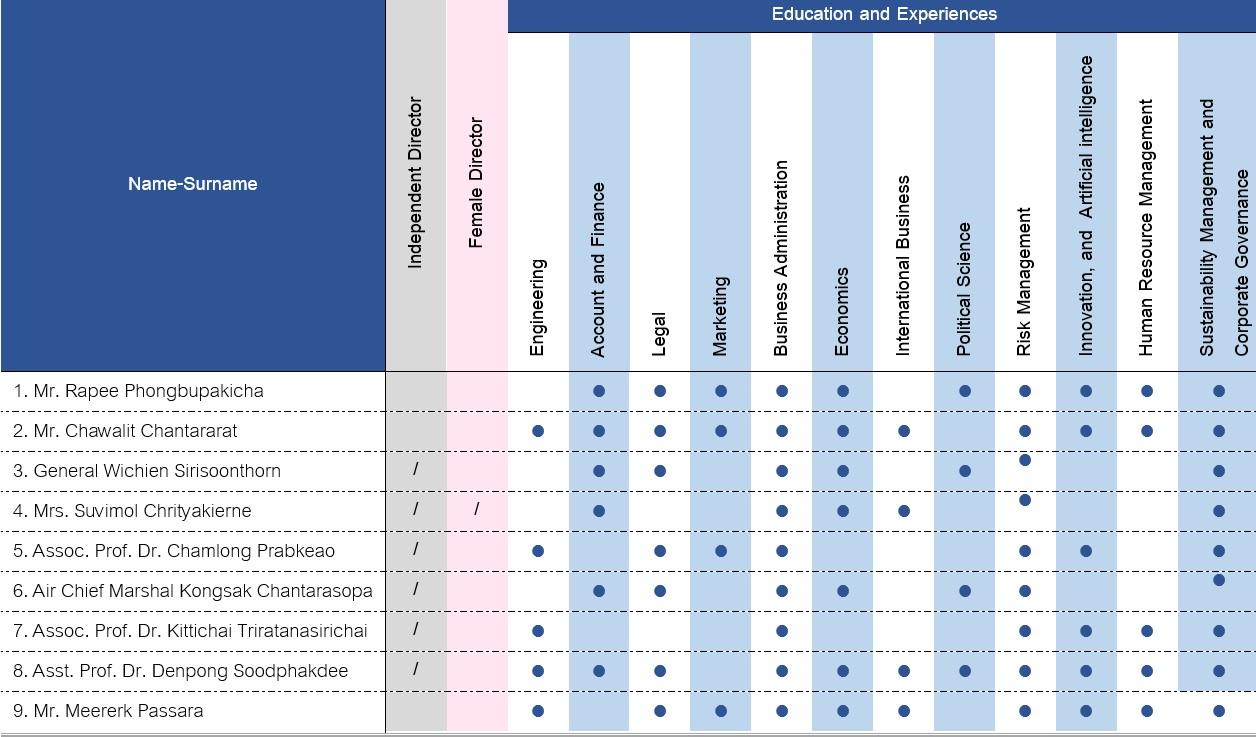
The Company recognizes the crucial role of the Board of Directors in setting strategic direction, overseeing business operations, and building confidence among all stakeholders. Adhering to principles of good corporate governance and sustainable business practices, the Company emphasizes structuring the Board with diverse knowledge, expertise, and experience, consistent with the Company's business nature, organizational strategy, and significant risks.
The Nomination and Remuneration Committee has established a Board Skills Matrix, considering the business context, economic environment, challenges in innovation and artificial intelligence, and the organization's growth direction. This competency framework is reviewed annually to ensure that the Board's composition remains appropriate and supports long-term business operations.
The Company stipulates that the Board of Directors should possess expertise covering various fields, including Engineering, Accounting and Finance, Legal, Marketing, Business Administration, Economics, International Business, Political Science, Risk Management, Innovation and Artificial Intelligence ( Innovation and Artificial Intelligence ), Human Resource Management, and Sustainability Management and Corporate Governance ( Sustainability Management and Corporate Governance) Such expertise helps foster a balance between technical, financial, legal, and management knowledge, as well as supporting corporate governance, risk management, organizational development, and adaptation to changes in the digital era, which are crucial factors for the Company's competitiveness and sustainable growth.
The following Board Skills Matrix table illustrates the comprehensive knowledge, abilities, and experience of the current Board of Directors which is consistent with the Company's business strategy. When compared to the competency framework set by the Company. to reflect the suitability of the Board's composition in effectively supporting the Company's strategy and corporate governance.
Qualifications for Director Selection
| Qualification | Skill & Expertise |
|---|---|
| The Company recognizes the crucial role of the Board of Directors in setting strategic direction, overseeing business operations, and building confidence among all stakeholders. Adhering to good corporate governance principles and sustainable business practices, the Company therefore prioritizes the composition of the Board to possess diverse knowledge, expertise, and experience, consistent with the nature of its business, organizational strategy, and significant risks. | 144 · Description: Finance · 159 · Description: Engineering · 165 · Description: Risk Management · 265 · Description: Governance/ Compliance · 1683 · Description: Business Administration |
Evaluation of Board & Subcommittee Performance
Criteria for Evaluating Board Performance
1. Guidelines for Implementation
The Board of Directors conducts performance evaluations of the entire Board, individual directors, the Audit Committee, the Nomination and Remuneration Committee, and the Chief Executive Officer at least once a year. During January, the Board will jointly consider performance and areas for improvement, which will enhance the collaborative efficiency of the Board, sub-committees, and the Chief Executive Officer.
The company has established a performance evaluation form for the Board of Directors, with evaluation criteria covering key aspects of good corporate governance, consistent with the Corporate Governance Code for listed companies (CG Code) of the Securities and Exchange Commission and international corporate governance practices, covering key issues such as:
Board Structure and Independence, such as the appropriateness of the number of directors, diversity of skills and experience, and the proportion of independent directors.
Roles and Responsibilities of the Board (Board Responsibilities) in setting the direction, strategy, and overseeing the company's operations.
Risk Management and Internal Control, including the oversight of transactions with conflicts of interest.
Transparency and Disclosure: To ensure shareholders and stakeholders receive accurate, sufficient, and timely information.
Efficiency of Board Meetings and Directors' Duties (Board Effectiveness), including expressing independent opinions and exercising impartial discretion.
Board Development and Succession Planning, such as director training, new director orientation, and executive succession planning.
The objective of establishing these evaluation criteria is to enhance the efficiency of corporate governance, transparency, and accountability to shareholders and stakeholders, leading to the company's sustainable business operations.
For the year 2025, the Board of Directors has conducted self-evaluations of the entire Board, individual directors, the Audit Committee as a whole, the Nomination and Remuneration Committee as a whole, and the performance evaluation of the Chief Executive Officer. The Board of Directors approved evaluation criteria adapted from the guidelines of the Stock Exchange of Thailand to suit the company's business nature and structure, to serve as a framework for considering the Board's duties and comprehensively monitoring issues related to the company's operations.
2. Evaluation Criteria
(1) Criteria for the Board of Directors' self-evaluation (evaluated as a whole) for the year 2025
1.1 Evaluation topics are divided into 6 main topics, namely:
Structure and Qualifications of the Board
Roles, Duties, and Responsibilities of the Board of Directors
Board Meetings
Performance of Directors' Duties
Relationship with Management
Director Self-Development and Executive Development
1.2 Evaluation criteria are calculated as a percentage of the full score for each item, as follows:
More than 90% equals Excellent
More than 80% equals Very Good
More than 70% equals Good
More than 60% equals Fair
Less than 60% equals Needs Improvement
(2) Criteria for individual directors' self-evaluation (self-assessment) for the year 2025
2.1 Evaluation topics are divided into 4 main topics, namely:
Structure and Qualifications of the Board
Performance of Directors' Duties
Board Meetings
Directors' Meetings
2.2 Evaluation criteria are calculated as a percentage of the full score for each item, as follows:
More than 90% equals Excellent
More than 80% equals Very Good
More than 70% equals Good
More than 60% equals Fair
Less than 60% equals Needs Improvement
(3) Criteria for self-evaluation of sub-committees, namely the Audit Committee (evaluated as a whole) and the Nomination and Remuneration Committee (evaluated as a whole) for the year 2025
3.1 Evaluation topics are divided into 3 Main Topics, including:
Structure and Qualifications of Sub-Committees
Board Meetings Sub-committees
Roles, Duties, and Responsibilities of Sub-Committees
3.2 Evaluation criteria are calculated as a percentage of the full score for each item, as follows:
More than 90% equals Excellent
More than 80% equals Very Good
More than 70% equals Good
More than 60% equals Fair
Less than 60% equals Needs Improvement
(4) Performance evaluation criteria for the Chief Executive Officer
To ensure effective monitoring and review of the Chief Executive Officer's management, the Board of Directors has mandated an annual performance evaluation for the Chief Executive Officer. The Chief Executive Officer Performance Evaluation Committee is tasked with developing and considering evaluation criteria for submission to the Board of Directors. These criteria are established to ensure that the Chief Executive Officer's management aligns with the company's objectives, main goals, strategies, and long-term interests, and that the evaluation criteria are communicated to the Chief Executive Officer in advance. The evaluation criteria are divided into 5 main parts.
Part 1: Measurement of performance based on Corporate Key Performance Indicators
Indicators) and Environmental, Social, and Governance (ESG) operations
Part 2: Measurement of administrative efficiency (Competency-based)
Part 3: Measurement of management skills (Management Skills-based)
Part 4: Environmental, Social, and Governance (ESG) Operations
Part 5: Overall evaluation summary
3. Evaluation Process
(1) Performance evaluation process for the Board of Directors and sub-committees
The Company Secretary has distributed performance evaluation forms to all directors to evaluate annual performance at the Board level, individual level, and for the sub-committees on which each director serves. Upon receiving all evaluation results, the Company Secretary summarized the results and reported them to the Board of Directors for consideration. The Board of Directors discussed these evaluation results to use them for improving the efficiency of directors' duties and to establish development plans to further enhance the Board's performance.
(2) Annual performance evaluation of the Chief Executive Officer 2025
The Board of Directors approved the establishment of criteria and the evaluation form for the Chief Executive Officer's performance.
The Chief Executive Officer Performance Evaluation Committee ("Evaluation Committee") conducts the evaluation. The Chief Executive Officer's evaluation process is as follows:
(1) The Chief Executive Officer self-evaluates according to the evaluation form and submits the self-evaluation results to the Evaluation Committee.
(2) The Evaluation Committee considers the Chief Executive Officer's performance evaluation form and jointly casts votes.
(3) The Evaluation Committee and the Chief Executive Officer jointly consider and discuss to finalize the evaluation results.
The Evaluation Committee reports the evaluation results to the Board of Directors for acknowledgment.
Evaluation of Board Performance in the Past Year
Self-assessment results of the Board of Directors, sub-committees, and the Chief Executive Officer
1. Self-assessment results of the Board of Directors (collective assessment) for the year 2025
Self-assessment results of the Board of Directors as a whole (collective assessment) for the year 2025 are at the level of “Excellent”, with a score level equal to 98.75%
2. Self-assessment results of individual directors (self-assessment) for the year 2025
Self-assessment results of individual directors (self-assessment) for the year 2568 is at the level of “Excellent” has a score level equal to 97.80%
The Board of Directors' performance assessment results for the year 2568 found that the performance is at an “Excellent” level. The Board of Directors considered these assessment results and provided collective feedback to be used as guidelines for further improving and developing the Board of Directors' operational efficiency.
3. Results Chief Executive Officer Performance Assessment for the Year 2568
Annual assessment results 2568 found that the Chief Executive Officer's performance is at mostly above expectations with no elements falling below expectations, reflecting the efficiency of organizational management in accordance with the objectives and goals set by the Board of Directors, covering financial management aspects such as revenue, net profit, and economic value added, as well as the results of sustainability initiatives, including 3 dimensions as part of the annual assessment criteria, where the Board of Directors has set sustainability indicators for the Chief Executive Officer, accounting for a percentage of 20 of all indicators 4 main sections For example, stakeholder satisfaction levels, quantifiable social benefits or returns generated for the community and society, reduction in resource consumption such as electricity, tap water, paper, and fuel for company vehicles, reduction in waste volume and greenhouse gas emissions, number of environmentally friendly projects, number of lost-time injury hours for employees, as well as prevention and action in cases of corruption or ethical breaches within the organization.
The Performance Evaluation Committee has prepared a report summarizing the Chief Executive Officer's performance assessment results, review areas for improvement, and proposing development guidelines for the Chief Executive Officer, to be presented to the Nomination and Remuneration Committee for consideration in determining the Chief Executive Officer's remuneration, and subsequently presented to the Board of Directors for further consideration.
Additionally, in 2026, the Board of Directors plans to expand the integration of Environmental, Social, and Governance (ESG) indicators into the performance assessment of senior executives, to ensure the integration of sustainability goals into the executive performance management system, and to continuously support the company's sustainability strategy.
Evaluation Results
| Evaluated Body | Group — Carried Out? | Group — Grade / Average Score | Group — Grade / Full Score | Individual (Self-Assessment) — Carried Out? | Individual (Self-Assessment) — Grade / Average Score | Individual (Self-Assessment) — Grade / Full Score | Cross (Assessing Other Directors) — Carried Out? |
|---|---|---|---|---|---|---|---|
| Board Of Director | Y | 98.75 | 100 | Y | 97.80 | 100 | N |
| Audit Committee | Y | 100 | 100 | N | N | ||
| Other Subcommittee | Y | 92.12 | 100 | N | N |
Subcommittees
Subcommittees
| Results of the Subcommittee's Duty Performance |
|---|
In 2025, the Nomination and Compensation Committee performed its duties in full compliance with its Charter. The Committee convened a total of six meetings, with an attendance rate of 100%. The key activities are summarized as follows:
The Nomination and Compensation Committee has duly performed its assigned duties with prudence, diligence, transparency, and fairness, taking into consideration the best interests of shareholders and all stakeholders. The Committee is of the opinion that the Board of Directors and sub-committees are of high quality, operate in accordance with good corporate governance principles, maintain effective working standards, uphold business ethics, and comply with relevant regulations, in line with the requirements of the Securities and Exchange Commission and the Stock Exchange of Thailand. |
In 2025, the Corporate Governance and Sustainability Committee (“CGS Committee”) convened a total of three meetings, with directors’ attendance at 100%. The results of each meeting were reported to the Board of Directors for acknowledgment. During the year, the CG Committee’s key activities can be summarized as follows:
The Corporate Governance and Sustainability Committee has duly performed its assigned duties to the best of its ability, with due consideration of the best interests of shareholders and all stakeholders. The Committee operates in accordance with good corporate governance principles, upholds business ethics, and complies with relevant regulations, in line with the requirements of the Securities and Exchange Commission and the Stock Exchange of Thailand. |
In 2025, amid volatility in external factors and the emergence of new technologies, the Risk Management Committee performed its duties with prudence and due diligence, while adhering to good corporate governance principles. The Committee convened a total of four meetings, with full attendance by all members, representing 100% participation. The outcomes of each meeting were reported to the Board of Directors on a quarterly basis for consideration, ensuring that the Company maintains a robust preventive system and fosters opportunities for sustainable growth. The key highlights of the Committee’s performance are summarized as follows: 1. Proactive Risk Management Toward AAA Sustainability Standards The Company emphasizes the integration of risk management with environmental, social, and governance (ESG) dimensions in a unified and holistic manner. This approach has led to recognition at both international and national levels, as reflected in the following key achievements:
2. Top Risk Management (Five Dimensions of Key Risk Governance)The Risk Management Committee has rigorously overseen and monitored the status of key risks in accordance with COSO ERM 2017 standards and the guidelines of the Stock Exchange of Thailand, integrating sustainability dimensions into the risk management process, covering all five dimensions as follows: Dimension 1: Strategic & Market Risk (SR1, SR2)
Dimension 2: Operational & Business Risk (BR1, BR4, BR5)
Dimension 3: Financial Risk (BR2)
Dimension 4: Compliance Risk (BR3, BR6)
Dimension 5: Emerging Risks (ER1, ER2, ER3) The Committee has assessed risks over the next 1–5 years to establish proactive measures aligned with regulatory requirements and international standards, as follows:
To ensure that risk management becomes an integral part of routine operations and is embedded as a sustainable business practice, the Committee has driven key initiatives to establish a strong foundation as follows:
In summary, the Risk Management Committee is confident that an effective and comprehensive risk management system will serve as a key mechanism to safeguard the organization’s value, while also creating added value for shareholders and all stakeholders in a stable and sustainable manner over the long term |
In 2025, the CEO Performance Review Committee convened a total of five meetings, with full attendance by all members (100%). The key activities are summarized as follows:
The Performance Evaluation Committee has duly carried out its assigned duties with due care, prudence, thoroughness, and to the best of its abilities. Its operations have been conducted with transparency and fairness, in alignment with good corporate governance principles, and with due regard to the best interests of the shareholders and all stakeholders. |
In 2025, the Innovation and Artificial Intelligence Committee convened a total of 2 meetings. All committee members attended every meeting, representing 100% attendance. The meetings served as a platform for exchanging views and providing constructive recommendations on relevant matters beneficial to the Company’s management. The key outcomes of each meeting were duly reported to the Board of Directors for acknowledgment on every occasion Over the past year, the Innovation and Artificial Intelligence Committee has achieved the following key performance outcomes: 1. Key Performance of the Innovation and Artificial Intelligence Committee During the past year, the Innovation and Artificial Intelligence Committee has performed its duties in accordance with the scope of authority, roles, and responsibilities as stipulated in the Committee’s Charter. The Committee has focused on promoting and driving the adoption of innovative technologies and artificial intelligence in the Company’s business operations to enhance operational efficiency, strengthen competitiveness, and support the Company’s sustainable growth. The key performance highlights can be summarized as follows: 2. Determination of Strategies and Direction for Innovation and Artificial Intelligence The Committee has jointly formulated and reviewed the Company’s innovation and artificial intelligence strategies and development directions to ensure alignment with the organization’s goals and strategic plans, and has subsequently proposed them to the Board of Directors for consideration and approval 3. Driving the adoption of innovation and artificial intelligence in operations The Board has driven the adoption and application of innovative technologies and artificial intelligence in the Company’s operations to enhance efficiency, streamline processes, and support the modernization of workflows in alignment with technological advancements 4. Oversight and Monitoring of the Implementation of Innovation and Artificial Intelligence Projects The Board has overseen, monitored, and provided guidance to the relevant departments in the implementation of the Company’s innovation and artificial intelligence projects to ensure that such projects proceed in accordance with the established plans and achieve their intended objectives 5. Oversight of Innovation and Artificial Intelligence Risk Management The Board has monitored and overseen the management of risks associated with the adoption of innovation and artificial intelligence in the Company’s operations, to ensure that such technologies are implemented appropriately, securely, and in alignment with the Company’s risk management framework 6. Promotion of an Organizational Culture of Innovation and Learning The Board has supported and overseen the development of an organizational culture that promotes learning, innovation, and artificial intelligence among the Company’s personnel. The Board has also encouraged collaboration with partners and external organizations to enhance knowledge development and strengthen the Company’s capabilities 7. Monitoring the Implementation of Innovation and Artificial Intelligence within the Organization The Committee has evaluated and monitored the progress of implementing innovation and artificial intelligence in the operations of various departments within the Company to ensure that such initiatives enhance efficiency and create added value for the organization. In addition, the Innovation and Artificial Intelligence Committee has the authority to request information and clarifications from relevant internal departments to support its deliberations and to promote the effective implementation of innovation and artificial intelligence initiatives. The Committee also performs other duties as assigned by the Board of Directors The Innovation and Artificial Intelligence Committee has fully performed its assigned duties with prudence, due care, diligence, transparency, and fairness. The Committee also operates in accordance with the principles of good corporate governance, with due regard to the best interests of shareholders and all stakeholders. |
Meeting Attendance & Remuneration
Justification for Directors' Non-Attendance
On occasion, a company director may be unable to attend a Board of Directors meeting due to urgent commitments and/or health issues, which constitute unforeseen circumstances. The director will inform the Company Secretary in advance of their inability to attend the meeting (where practicable), and the company will provide the meeting documents to the said director for their acknowledgement, to enable continuous monitoring of the meeting outcomes and key issues discussed.
Types of Remuneration of the Board of Directors
1) Monetary remuneration
At the Annual General Meeting of Shareholders 2025, on April 28, 2025, a resolution was passed to approve the remuneration for the Board of Directors, the Audit Committee, and the Nomination and Remuneration Committee. Annually 2025 for a total amount of not exceeding 8,800,000 Baht and also to pay a bonus Annually 2024 Number 2,972,200 Baht, with the following details:
Committee | Remuneration (per person) |
1. Remuneration of the Board of Directors | |
1.1 Monthly director's remuneration | |
| 37,500 Baht/month |
| 32,500 Baht/month |
| 25,000 Baht/month |
1.2 Meeting allowance | |
| 7,500 Baht/meeting |
| 6,500 Baht/meeting |
| 5,000 Baht/meeting |
1.3 Bonus | |
2. Remuneration of the Audit Committee | |
2.1 Monthly director's remuneration | |
| 30,000 Baht/month |
| 20,000 Baht/month |
2.2 Meeting allowance | |
| 7,500 Baht/meeting |
| 5,000 Baht/meeting |
3. Remuneration of the Nomination and Remuneration Committee | |
3.1 Monthly director's remuneration |
|
3.2 Meeting allowance | |
| 7,500 Baht/meeting |
| 5,000 Baht/meeting |
4. Remuneration of the Corporate Governance and Sustainability Committee | |
4.1 Monthly director's remuneration |
|
4.2 Meeting allowance | |
| 7,500 Baht/meeting |
| 5,000 Baht/meeting |
5 . Remuneration of the Risk Management Committee 5 . 1 Monthly director's remuneration 5 . 2 Meeting allowance
|
7,500 Baht/meeting 5,000 Baht/meeting |
6 . Remuneration of the Performance Evaluation Committee of CEO 6 . 1 Monthly director's remuneration 6 . 2 Meeting allowance
|
7,500 Baht/meeting 5 ,000 Baht/meeting |
7 . Remuneration of the Innovation and Artificial Intelligence Committee 7 . 1 Monthly director's remuneration 7 . 2 Meeting allowance
|
7 ,500 Baht/meeting 5 ,000 Baht/meeting |
8. Other Remuneration and Benefits |
|
Note:
The company pays for accommodation and vehicle rental fees for directors to attend meetings at the company's office and for the performance of directors' duties, based on actual expenses.
Directors who are company executives from the CEO level downwards will not be entitled to monthly director's remuneration and meeting allowances.
2) Other remuneration
The company does not provide any other benefits to directors. However, the company is responsible for the expenses of attending training and seminar courses of the Thai Institute of Directors Association and other related institutions, including accommodation and vehicle rental fees for directors who do not reside in Bangkok and its vicinity, to support the efficient performance of the company's directors. Additionally, the company has arranged Directors and Officers Liability Insurance (Directors and Officers Liability Insurance: D&O) Other benefits are provided to directors with a coverage limit of 100 million Baht, with an insurance period of 1 year.
Remuneration or Benefits Payable to the Board
| Metric | Amount (Baht) |
|---|---|
| Remunerations or benefits pending payment to the board of directors over the past year (baht) | 3,170,000 |
Supervision of Subsidiaries & Associated Companies
Supervision of Subsidiaries — Introduction
In supervising the operations of its subsidiaries and associated companies, the Company has assigned representatives to serve as directors in such subsidiaries and associated companies. The Company's representatives may include the Chairman, Company Director, Chief Executive Officer, Managing Director, senior executives, or other individuals with appropriate qualifications and experience in the respective businesses, and must be free from conflicts of interest with the businesses of the subsidiaries and associated companies. Furthermore, the Company's representatives serving as directors in subsidiaries must perform their duties to manage and operate the subsidiary's business in accordance with the rules, regulations, and operational authority ( Delegation of Authority ) stipulated by the Company, as well as comply with the relevant laws of the subsidiaries.
To protect the Company's investment interests and to enable the Company to oversee the management and be responsible for the operations of its subsidiaries as if they were part of the Company, the Board of Directors' meeting resolved to approve the policy on the supervision of subsidiaries and associated companies, with the following key principles:
Policy on Management Control of Subsidiaries and Associated Companies
The Company has established guidelines for the exercise of voting rights by the Company's representatives at shareholders' meetings of subsidiaries and associated companies on important matters such as the election of directors and determination of remuneration, appointment of auditors, profit allocation, and consideration of other matters not specified in advance on the agenda. Furthermore, the Company has stipulated cases requiring approval from the Board of Directors' meeting or the shareholders' meeting (as the case may be) to ensure prudent and transparent supervision. The Company monitors the performance of subsidiaries and associated companies to ensure compliance with established plans, requires the disclosure of related party transactions of subsidiaries, ensures that subsidiaries have appropriate and adequate internal control systems, and mandates the disclosure and submission of information regarding directors, executives, and related persons of subsidiaries, while strictly overseeing the use of inside information.
In addition, the Company has stipulated that matters or agendas of significant importance must be approved by the Board of Directors' meeting or the Company's shareholders' meeting, depending on the level of importance of each case.
Policy on Financial Control of Subsidiaries and Associated Companies
The Company has stipulated that subsidiaries and associated companies must submit their quarterly operating results and financial statements, including supporting information for the preparation of such financial statements, to the Company for the purpose of preparing consolidated financial statements and quarterly performance reports. Furthermore, subsidiaries and associated companies are required to report significant financial issues to the Company immediately upon detection or upon request from the Company, to enable the Company to conduct an appropriate examination and follow-up.
In addition, the Company has stipulated that the Company's directors are responsible for continuously monitoring the performance of subsidiaries and associated companies to ensure compliance with established plans and budgets, as well as ensuring that subsidiaries disclose related party transactions and the acquisition or disposal of assets to the Company strictly in accordance with the relevant announcements of the Securities and Exchange Commission and the Stock Exchange of Thailand.
Does the Company Have Subsidiaries or Associated Companies?
Yes
Is There a Mechanism for Overseeing Subsidiaries and Associated Companies?
Yes
Mechanism for Overseeing Management of Subsidiaries
1. Management Control Policy for Subsidiaries and Joint Ventures
1.1 The company establishes guidelines for exercising voting rights through its representatives at the shareholders' meetings of subsidiaries and joint ventures regarding the approval of minutes of ordinary and/or extraordinary shareholders' meetings, approval of annual financial statements, election of directors and determination of their remuneration, appointment of auditors and determination of audit fees, allocation of profits, approval of other matters, and consideration of other matters not predetermined on the agenda, to align with the shareholding proportion in subsidiaries and joint ventures. This is also to comply with good corporate governance practices and to preserve the utmost benefit of the company, its subsidiaries, joint ventures, and other shareholders collectively.
1.2 To enable the company to control, supervise management, and be responsible for the operations of subsidiaries and joint ventures as if they were part of the company, and to ensure the company has direct and indirect mechanisms to oversee subsidiaries and joint ventures, as well as measures to monitor the management of subsidiaries and joint ventures to protect the company's investment interests, the following cases must receive approval from the company's Board of Directors meeting or the shareholders' meeting (as the case may be).
1.2.1 Matters requiring approval from the company's Board of Directors meeting.
(a) The appointment or nomination of individuals as directors or executives in subsidiaries or joint ventures, at least in proportion to the company's shareholding in such subsidiaries and joint ventures. The directors and executives nominated or appointed by the company shall have the discretion to cast votes in the board meetings of the subsidiaries and joint ventures on matters related to general management and the normal business operations of the subsidiaries and joint ventures, as deemed appropriate by the directors and executives of the subsidiaries and joint ventures, for the utmost benefit of the company, its subsidiaries, and joint ventures. Except for matters specified in item ( 1.2.2)
Furthermore, the nominated directors or executives mentioned in the preceding paragraph must possess the qualifications, roles, duties, and responsibilities, and must not exhibit characteristics indicating a lack of trustworthiness as stipulated in the announcement of the Securities and Exchange Commission regarding the determination of characteristics indicating a lack of trustworthiness of directors and executives of the company.
(b) Consideration of annual dividends and interim dividends (if any) of the subsidiary.
(c) Amendment of the subsidiary's articles of association.
Items (d) to (j) are considered significant transactions, and if entered into, will have a significant impact on the financial position and operating results of the subsidiary. Before any board meeting of the subsidiary, directors and executives appointed by the company to positions in the subsidiary, when casting votes on the following matters, must first obtain approval from the company's board of directors. This must be a case where, when calculating the size of the transaction entered into by the subsidiary compared to the size of the company, by applying the criteria stipulated in the announcements of the Securities and Exchange Commission and the Stock Exchange of Thailand regarding the acquisition or disposition of assets mutatis mutandis, it falls within the scope requiring consideration and approval from the company's board of directors. The following are these transactions:
(d) In cases where a subsidiary agrees to enter into a transaction with a connected person of the subsidiary, or a transaction involving the acquisition or disposition of assets of the subsidiary.
(e) The transfer or waiver of benefits, including the waiver of claims against those who caused damage to the subsidiary.
(f) The sale or transfer of all or a significant part of the subsidiary's business to another person.
(g) The acquisition or transfer of another company's business to the subsidiary.
(i) Entering into, amending, or terminating contracts related to the lease of all or a significant part of the subsidiary's business, assigning another person to manage the subsidiary's business, or merging businesses with another person.
(h) The lease or hire-purchase of all or a significant part of the subsidiary's business or assets.
(l) Borrowing, lending, granting credit, providing guarantees, entering into legal acts that obligate the subsidiary to incur additional financial burdens, or providing any other form of financial assistance to other persons, and which are not part of the subsidiary's normal business.
(k) The dissolution of a subsidiary.
(j) Any other transaction that is not a normal business transaction of the subsidiary and will have a significant impact on the subsidiary.
1.2.2 Matters requiring approval from the company's shareholders' meeting with a vote of not less than three-fourths (3/4) of the total votes of shareholders attending the meeting and having the right to vote, before the subsidiary enters into a transaction.
(a) In cases where a subsidiary agrees to enter into a transaction with a connected person of the subsidiary, or a transaction involving the acquisition or disposition of assets of the subsidiary, by applying the criteria stipulated in the relevant announcements of the Securities and Exchange Commission and the Stock Exchange of Thailand (as the case may be), mutatis mutandis. This must be a case where, when calculating the size of the transaction entered into by the subsidiary compared to the size of the company according to the said criteria, it falls within the scope requiring approval from the company's shareholders' meeting according to the said criteria.
(b) Capital increase through the issuance of new shares by the subsidiary and the allocation of shares, as well as a reduction in registered capital that is not in proportion to the original shareholding of shareholders, which would result in the company's direct and indirect shareholding proportion in the subsidiary, at any level, decreasing by more than percent. 10 of the paid-up capital of that subsidiary, or results in the company's direct and indirect shareholding proportion in the subsidiary, at any level, decreasing to less than 50 percent of the paid-up capital of that subsidiary.
(c) Any other action that would result in the company's direct and indirect shareholding proportion in the subsidiary, at any level, decreasing by more than 10 percent of the subsidiary's paid-up capital, or resulting in the company's direct and indirect shareholding proportion in the subsidiary, at any level, decreasing to less than 50 percent of the subsidiary's paid-up capital, when entering into any other transaction that is not a normal business transaction of the subsidiary.
(d) The dissolution of a subsidiary. This must be a case where, when calculating the size of the dissolved subsidiary's business compared to the size of the company, by applying the criteria stipulated in the announcements of the Securities and Exchange Commission and the Stock Exchange of Thailand regarding the acquisition or disposition of assets, mutatis mutandis. This must be a case where, when calculating the size of the transaction entered into by the subsidiary compared to the size of the company, it falls within the scope requiring approval from the company's shareholders' meeting.
(e) Any other transaction that is not a normal business transaction of the subsidiary and will have a significant impact on the subsidiary. This must be a case where, when calculating the size of any other transaction that is not a normal business transaction of the subsidiary compared to the size of the company, by applying the criteria stipulated in the announcements of the Securities and Exchange Commission and the Stock Exchange of Thailand regarding the acquisition or disposition of assets, mutatis mutandis. This must be a case where, when calculating the size of the transaction entered into by the subsidiary compared to the size of the company, it falls within the scope requiring consideration and approval from the company's shareholders' meeting.
1.3 The company's directors shall continuously monitor the performance of subsidiaries and joint ventures to ensure compliance with plans and budgets, and shall ensure that subsidiaries disclose information on connected transactions and the acquisition or disposition of assets to the company, in full and accurately, by applying the relevant announcements of the Securities and Exchange Commission and the Stock Exchange of Thailand (as the case may be) mutatis mutandis.
1.4 The company's directors must ensure that subsidiaries engaged in core businesses have appropriate and robust internal control systems sufficient to prevent potential fraud within the subsidiaries. Furthermore, subsidiaries must establish clear operational systems to demonstrate that they have adequate systems for continuously and reliably disclosing significant transaction information according to established criteria. There must also be channels for the company's directors and executives to access subsidiary information to effectively monitor performance, financial status, transactions between subsidiaries and their directors and executives, and significant transactions of the subsidiaries. In addition, subsidiaries must have mechanisms to audit such operational systems within the subsidiaries, allowing the internal audit team and independent directors of the company direct access to information, and ensuring that the results of such system audits are reported to the company's directors and executives to ensure that subsidiaries consistently comply with the established operational systems.
1.5 Directors and executives of subsidiaries must disclose and submit information regarding their interests and those of related persons to the company's board of directors, informing them of relationships and transactions with the company that may give rise to conflicts of interest, and must avoid entering into transactions that may create conflicts of interest with the subsidiary or the company. The subsidiary's board of directors is responsible for notifying the company's board of directors of such matters within the timeframe specified by the company, to serve as information for any consideration, decision, or approval. Such consideration shall primarily take into account the overall benefit of the subsidiary and the company. Furthermore, directors of the subsidiary must not participate in approving matters in which they have a direct or indirect interest or conflict of interest. Moreover, the following actions, which result in directors, executives, or related persons of the subsidiary receiving financial benefits other than what is normally due, or cause damage to the subsidiary or the company, shall be presumed to be actions significantly contrary to or conflicting with the interests of the subsidiary.
(a) Transactions between the subsidiary and its directors, executives, or related persons that do not comply with the criteria for connected transactions.
(b) The use of confidential information of the company or its subsidiaries, unless such information has already been disclosed to the public.
(c) The use of assets or business opportunities of the company or its subsidiaries in a manner similar to that of the company, which violates the criteria or general practices stipulated by the Securities and Exchange Commission.
1.6 Subsidiaries must report their business plans, business expansion, large investment projects, as well as joint ventures with other operators to the company through monthly performance reports. The company has the right to request subsidiaries to clarify or submit supporting documents for such consideration, which subsidiaries must strictly comply with immediately.
1.7 Subsidiaries must submit relevant operational information or documents to the company upon reasonable request.
1.8 In cases where the company identifies any significant issues, it may request the subsidiary to provide clarification and/or submit documents for the company's consideration.
1.9 Directors, executives, employees, staff, or assignees of subsidiaries and joint ventures, including their spouses and minor children, are prohibited from using inside information of the company and its subsidiaries or joint ventures, whether obtained through their duties or otherwise, that has or may have a significant impact on the company, subsidiaries, or joint ventures, for their own benefit or the benefit of others, whether directly or indirectly, and regardless of whether remuneration is received.
1.10 Directors, executives, or related persons of a subsidiary may conduct transactions with the subsidiary only if such transactions have been approved by the company's board of directors or the company's shareholders' meeting (as the case may be), depending on the calculated transaction size, by applying the criteria stipulated in the announcement on connected transactions and relevant criteria set by the Securities and Exchange Commission and the Stock Exchange of Thailand mutatis mutandis. This excludes transactions that are commercial agreements of the same nature as those a reasonable person would enter into with general counterparties in similar circumstances, with commercial bargaining power, free from the influence of their status as a director, executive, or related person, as the case may be, and are commercial agreements approved by the company's board of directors or are in accordance with principles already approved by the company's board of directors.
2. Financial Control Policy for Subsidiaries and Joint Ventures
2.1 Subsidiaries and joint ventures are responsible for submitting monthly operating results and quarterly financial statements, as well as supporting information for the preparation of such financial statements, to the company. They must also consent to the company's use of such information for the preparation of consolidated financial statements or the company's quarterly or annual performance reports, as the case may be.
2.2 Subsidiaries and joint ventures are responsible for preparing performance budgets and quarterly summaries comparing actual performance against operational plans, as well as monitoring performance to ensure it aligns with the plan, for reporting to the company.
2.3 Subsidiaries and joint ventures are responsible for reporting significant financial issues to the company upon discovery or when requested by the company to conduct an investigation and report.
Oversight Mechanisms
| Mechanism |
|---|
| Sending representatives to act as directors, executives or controlling persons in proportion to shareholdings |
| Disclosure of financial information and operating results |
| Defining the scope of powers, duties and responsibilities of directors and executives who represent the company in setting important policies |
| Transactions between the Company and related persons |
| Other important transactions |
| Acquisition or disposal of assets |
| Internal control system of the subsidiary operating the core business is appropriate and sufficient in the subsidiary operating the core business |
Audit Committee Duty Performance
Results of the Audit Committee's Duty Performance in the Past Year
The Audit Committee of TEAM Consulting Engineering and Management Public Company Limited (the "Company") comprises three independent directors with diverse knowledge, expertise, and experience in management, accounting, finance, and risk management. The three independent directors are independent and have the suitable qualifications to perform their duties in reviewing the financial statements, which assures accountability in compliance with the regulations of the Securities and Exchange Commission and the Stock Exchange of Thailand. The Committee is chaired by Mrs. Suvimol Chrityakierne, Chairman of the Audit Committee, with General Wichien Sirisoonthorn and Air Chief Marshal Kongsak Chantarasopa as members, and Ms. Pommara Patthanabhumthanint, the Company Secretary, as Secretary of the Audit Committee.
The Audit Committee has performed their duties independently by the Board of Directors’ assignment in accordance with the scope of responsibilities stated in the Company's Audit Committee Charter, which is in line with the requirements of the Securities and Exchange Commission and the Stock Exchange of Thailand. The Audit Committee emphasizes compliance with the Corporate Governance Code, laws, rules, and regulations with regard to business operations both domestically and internationally in order to increase the Company’s value. The Audit committee also reviews and ensures the accuracy and reliability of the Company’s financial report, conducts an adequate and appropriate internal control system and internal audit, as well as reviews the connected transactions and risk management effectively.
In the fiscal year of 2025, the Audit Committee held a total of 5 meetings with 100% attendance of all members. In each meeting, the Company's management, external auditors, and internal auditors were presented to exchange and suggest ideas and recommendations on related issues that were beneficial to the Company’s operation. The summary of each meeting of the Audit Committee was always presented at the Board of Directors Meeting.
In addition, the Audit Committee convened a private meeting between the Audit Committee and the external auditor, without the presence of the Company’s management, on one occasion. The purpose of the meeting was to discuss the audit plan, internal control system, complaints and fraud, the auditor’s independence in the performance of duties and expression of opinions, Key Audit Matters (KAM), and disclosures in compliance with applicable standards.
In the previous year, the Audit Committee's key performance can be summarized as follows:
1. Review of Financial Statements for 2025
The Audit Committee has reviewed the Company’s and its subsidiaries’ quarterly and annual financial statements to ensure their accuracy, completeness, and adequate disclosure. In this regard, the Audit Committee held discussions with the external auditor and the Company’s management on key matters, including the accuracy and reliability of the financial statements, significant accounting adjustments affecting the financial statements, and the adequacy of disclosures therein. The Audit Committee is of the opinion that the Company’s financial statements have been properly prepared in accordance with generally accepted accounting standards, prior to their submission to the Board of Directors for approval.
2. Review of the Internal Control System
The Audit Committee reviewed the annual audit plan as proposed by the internal auditor, provided recommendations, and monitored the implementation of corrective actions on significant findings to ensure good corporate governance and adequate internal control systems. The Committee also reviewed the results of the internal control assessment reported by the internal auditor, which covered entity-level controls, compliance with applicable laws and regulations, project management, procurement management, asset management, human resource management, and information technology security (IT Security). Based on such a review, the internal control system was found to be effective and efficient, consistent with the auditor’s opinion that no material issues or significant deficiencies were identified. Accordingly, the Audit Committee is of the opinion that the Company has adequate and appropriate internal control systems in line with the objectives and components of internal control.
3. Review of Risk Management
The Audit Committee has reviewed the Company’s risk management system to ensure that it is appropriate and effective. The Risk Management Committee is specifically responsible for overseeing risk management, covering the approval of policies and frameworks, as well as the establishment of measures and the development of risk management plans to prevent or mitigate potential impacts on business operations to an acceptable level. The Company also monitors changes in both internal and external factors and regularly reviews risks in order to enhance its risk management to respond to changes effectively and in a timely manner. The Risk Management Committee reports the progress of risk management to the Board of Directors on a quarterly basis. In addition, the Audit Committee has assessed the effectiveness of risk management based on internal control audit reports from the internal auditor and the external auditor. The Audit Committee is of the opinion that the Company’s risk management system is appropriate and adequate.
4. Review and Oversight of the Internal Audit
The Audit Committee approved the appointment of the office of Pitisevi Co., Ltd. to serve as the internal auditor of the Company and its subsidiaries. The Committee also reviewed the adequacy, appropriateness, and effectiveness of the Company’s internal audit system to obtain reasonable assurance that the Company’s operations are conducted efficiently and effectively. Such review was based on the internal auditor’s reports on audits and reviews of the Company’s key processes in accordance with the approved Internal Audit Plan for the year 2025, as well as the assessment of the adequacy of the internal control systems of the Company and its subsidiaries. The internal auditor prepared reports on the internal control system, which were presented to the Audit Committee and the Board of Directors for acknowledgment. In addition, the Audit Committee reviewed the annual internal audit plan to ensure that it is capable of identifying deficiencies in the internal control system and that appropriate improvements are made in response to changing circumstances. The Audit Committee is of the opinion that the Company’s internal audit system is adequate and effective, and aligned with the established objectives.
5. Review of Connected Transactions or Transactions that May Have Conflicts of Interest
The Audit Committee monitored and reviewed the Company’s connected transactions or transactions that may give rise to conflicts of interest on a quarterly basis to ensure that such transactions were conducted in the ordinary course of business, based on accuracy and transparency, and in compliance with applicable laws and the regulations of the Stock Exchange of Thailand. The Audit Committee is of the opinion that the connected transactions or transactions that may give rise to conflicts of interest during 2025 were necessary for business operations, conducted through transparent and fair processes, and in the best interests of the Company. Such transactions were reasonable, undertaken in the ordinary course of business under normal commercial terms, and treated on the same basis as those with unrelated parties. In addition, the pricing and conditions of such connected transactions were determined on an arm’s length basis, in accordance with the Company’s policy on connected transactions.
6. Review of Legal Compliance
The Audit Committee reviewed and supervised the Company's operations in accordance with the Securities and Exchange Act, Regulations of the Stock Exchange of Thailand, including policies, rules, regulations, and other laws related to the Company's business operations. In the year 2025, there were no operations that were contrary to the requirements, laws, and related regulations. Therefore, the Audit Committee is of the opinion that the Company has complete and effective internal control procedures in compliance with the aforementioned laws and regulations.
7. Review of Good Corporate Governance and Anti-Corruption Practices
The Audit Committee places strong emphasis on conducting business with integrity and upholding good corporate governance principles. Accordingly, it has exercised prudent oversight with fairness and transparency, and has reviewed the Company’s complaint handling and whistleblowing processes to ensure alignment with good corporate governance practices. The Committee has also overseen the full and proper disclosure of information in compliance with the requirements of the Stock Exchange of Thailand, and has regularly reviewed the adequacy and effectiveness of the Company’s internal control system, as well as its anti-fraud and anti-corruption measures. In 2025, no significant fraud cases or material complaints were identified, and the Company’s operations were conducted in an appropriate manner in accordance with transparency and good governance principles.
8. Consideration of the selection and nomination for appointment of the external auditor, and determination of the audit fee for the year 2025
The Audit Committee has considered and selected the external auditor, proposed the appointment of the auditor, and proposed the audit fees for the year 2025, and subsequently submitted the same to the Board of Directors for consideration and approval prior to seeking approval from the Annual General Meeting of Shareholders. The selection criteria include that the auditor must possess qualifications as prescribed by the Office of the Securities and Exchange Commission (SEC) and the Stock Exchange of Thailand (SET), as well as having knowledge, expertise in auditing, and independence in accordance with relevant legal requirements. The Annual General Meeting of Shareholders for the year 2025 resolved to approve the appointment of EY Office Limited as the Company’s auditor, namely Mrs. Chonlaros Suntiasvaraporn, Certified Public Accountant No. 4523, or Ms. Sirirat Sricharoensup, Certified Public Accountant No. 5419, or Ms. Watoo Kayankannavee, Certified Public Accountant No. 5423, or other Certified Public Accountants from the same firm, as the Company’s auditors for the fiscal year 2025 ending December 31, 2025. The total audit fee, comprising the annual audit fee and the quarterly review fees, is Baht 2,880,000 (Two million eight hundred eighty thousand baht only).
9. Review and Approval of the Company’s Audit Committee Charter
The Audit Committee considered and approved the revision of the Company’s Audit Committee Charter to be more in line with the Corporate Governance Code, and then proposed to the Board of Directors for approval. The Charter shall be used as a guideline for the Audit Committee’s work.
In conclusion, in 2025, the Audit Committee has fully performed its duties as stipulated in the Audit Committee Charter approved by the Board of Directors, with full knowledge, independence, and extreme caution for the maximum benefit of all shareholders and stakeholders in an equitable manner. The Audit Committee is of the opinion that the Company's financial statement is accurate, reliable, and in accordance with Generally Accepted Accounting Principles. The Company has adequate information disclosure, an appropriate risk management system in compliance with all relevant laws and regulations correctly and completely, an effective internal control system in response to the changes arising from both internal and external factors, and operates significantly in accordance with the Corporate Governance Code.
Executive Committee Duty Performance
Results of the Executive Committee's Duty Performance in the Past Year
In 2025, the Executive Committee performed its duties independently within the scope of responsibilities assigned by the Board of Directors, as stipulated in the Company’s Executive Committee Charter, which fully complies with the requirements of the Office of the Securities and Exchange Commission and the Stock Exchange of Thailand. The Committee focused on ensuring that the Company adheres to good corporate governance principles and complies with applicable laws, rules, and regulations governing its business operations both domestically and internationally, with the aim of enhancing organizational value. The Committee also reviewed the accuracy and reliability of financial reports, ensured that internal control and internal audit systems are adequate and appropriate, and reviewed related party transactions and risk management to ensure effectiveness and efficiency.
In 2025, the Executive Committee convened a total of 13 meetings, with an attendance rate of 93.40% by all members. Each meeting was conducted in conjunction with the Company’s management to exchange views and provide recommendations on matters relevant to the Company’s operations. The outcomes of each meeting were summarized and reported to the Board of Directors on a quarterly basis.
Over the past year, the Executive Committee has achieved the following key performance outcomes:
1. Key Performance of the Executive Committee
During the past year, the Executive Committee has performed its duties in accordance with the scope of authority, duties, and responsibilities as stipulated in the Executive Committee Charter. The Committee has focused on overseeing the Company’s management to ensure alignment with the policies and directions set by the Board of Directors, as well as supervising business operations to be conducted efficiently, transparently, and in compliance with applicable laws and regulations.
2. Oversight of the Company’s Management
The Executive Committee has supervised and overseen the Company’s management to ensure alignment with the policies and directions established by the Board of Directors. It has also continuously monitored the Company’s operational performance and periodically reported progress and key issues to the Board of Directors for acknowledgment and consideration.
3. Determination of Approval Authority and Operational Oversight
The Executive Committee has established appropriate levels of authority and approval limits for personnel within the organization. It has also defined a clear segregation of duties and responsibilities in operations to mitigate risks that may lead to fraud. In addition, guidelines and procedures for transactions involving major shareholders, directors, executives, or related parties have been established to prevent conflicts of interest. These principles are subsequently proposed to the Board of Directors for consideration and approval, and are subject to proper oversight to ensure effective implementation.
3. Consideration of Budget and Oversight of Expenditures
The Executive Committee has reviewed the Company’s annual budget, including the guidelines and procedures for budget utilization, and proposed it to the Board of Directors for approval. The Committee has also overseen the Company’s budget expenditures to ensure alignment with the approved plans and budget
4. Determination and Review of the Business Plan
The Executive Committee has considered and reviewed the Company’s business plan to ensure alignment with the changing business environment, enabling the Company to operate efficiently and achieve the greatest benefit for the organization
5. Consideration of Investment and Significant Contracts of the Company
The Executive Committee has considered and approved investments, including the determination of investment budgets, as well as the entry into contracts that are binding on the Company, within the scope of authority as specified in the Authorization Matrix. This is to ensure that the Company’s business operations are conducted prudently and appropriately.
6. Oversight of Key Information and Financial Reporting
The Executive Committee has overseen that the Company maintains sufficient key information necessary to support decision-making by the Board of Directors and shareholders. This includes ensuring that financial statements are prepared accurately, reliably, and in compliance with the relevant accounting standards
7. Consideration of Operating Results and Proposal for Dividend Payment
The Executive Committee has reviewed the Company’s operating results, including revenues, expenses, and profit and loss, and has proposed a guideline for the annual dividend payment to the Board of Directors for consideration
8. Consideration of New Business Initiatives and Business Restructuring
The Executive Committee has considered approaches for undertaking new business initiatives, including the improvement or discontinuation of certain business operations as deemed appropriate, for submission to the Board of Directors for approval
9. Oversight of Reporting Irregular Events and Legal Compliance
The Executive Committee has established and overseen procedures for reporting irregular events or actions that may violate applicable laws or relevant regulations. Such matters are required to be reported to the Executive Committee in a timely manner. In cases where the impact is significant, the matter shall be escalated to the Board of Directors for consideration and prompt corrective action
10. Oversight of Subsidiaries and Associated Companies
The Executive Committee has closely supervised the operations of subsidiaries and associated companies, including considering the appointment or nomination of individuals to serve as directors or executives in such entities, in order to ensure that business operations are aligned with the Company’s policies. In addition, the Executive Committee has regularly reported operational results and significant resolutions to the Board of Directors at subsequent meetings. The Committee has also performed other duties as assigned by the Board of Directors to support the Company’s business operations, ensuring efficiency and maximizing benefits for shareholders and all stakeholders